Finnish and Japanese graduates are likely to be higher performers than Brits, new analysis suggests Getty Images
British graduates are falling behind their Japanese,
and European counterparts, a new analysis of student performances from
across the world has revealed.
England and the United States may have dominated this year’s
top university rankings, but test results published by the Organisation
for Economic Co-operation and Development (OECD) suggests their
graduates’ literacy skills do not match up.
ADVERTISING
Taking into account a range of factors, including reputation
and research output, the QS World University Rankings for 2016-17 named
the Massachusettes Institute of Technology, Stanford and Harvard and as
the best institutions worldwide.
Read more
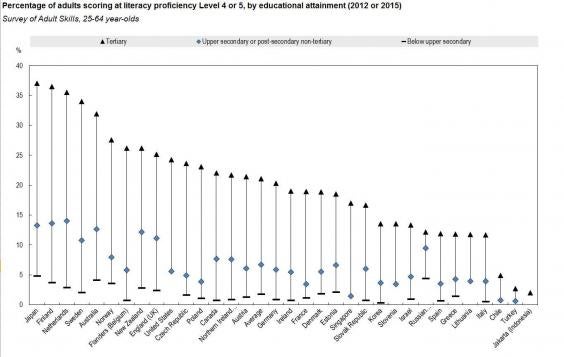
In a list of 35 OECD countries, however, the US comes in
ninth place, behind England in eighth place for advanced literary
skills.
According to the analysis, published in the OECD’s Education at a Glance
report, Japan is host to the most high-flying graduates, with Finland
in second place. Australia and New Zealand also top England and the US
in terms of ability.
Finland and Japan also come top in the OECD’s PISA rankings, compare secondary school standards around the globe.
Scotland and Wales are not included in the table, but Northern Ireland is marked at 14th place.
(OECD 2016)
South Korea and Singapore, both known for their high-achieving schools, also fall below average in the OECD graduate rankings.
The figures suggest that university reputation may not necessarily reflect student ability or graduate prospects.
Andreas Schleicher, the OECD's education director, says the
results show ability levels can “vary hugely among people with similar
qualifications”.
They might all have degrees, but “there are major differences in the quality of higher education”.
“When it comes to advanced literacy skills, you might be
better off getting a high school degree in Japan, Finland or the
Netherlands than getting a tertiary degree in Italy, Spain or Greece,”
he told the BBC.
According to the report, only 12 out of 35 OECD countries
with available data meet the benchmark for half of the Sustainable
Development Goal targets for education.
Finland and Japan also come top in the OECD’s PISA rankings, compare secondary school standards around the globe.
Some 36 per cent of today’s young adults are expected to
graduate before the age of 30, but only 41 per cent of full-time
bachelor students graduate within the theoretical duration.
The OECD list of top 10 highest performing graduates
1. Japan
2. Finland
3. Netherlands
4. Australia
5. Norway
6. Belgium
7. New Zealand
8. England
9. United States
Every year, the World Economic Forum releases its Global Competitiveness Report on the state of the world's economies.
The WEF looks at data on areas as varied as the soundness of
banks to the sophistication of businesses in each country. It then uses
the data to compile a picture of the economy of almost every country on
earth.
Countries were ranked according to the "12 pillars of
competitiveness," which includes macro-economic environment,
infrastructure, health and primary education, and labour market
efficiency.
We have drilled down into the schooling data to look at
which countries have the best education systems. Neither the US or the
UK make the grade in the top 11 (3 countries are tied for 9th, making 11
the clearest cut off point.)
Here are the ones that did make the grade:
=9. Japan: 5.6
Japan is one of the top performing countries for literacy,
science, and maths in the OECD group. Students go through six years of
elementary school, three years of junior high school, and three years of
high school before deciding whether they want to go to university. High
school is not compulsory but enrolment is close to 98%.
=9. Barbados: 5.9
The Barbados government has invested heavily in education,
resulting in a literacy rate of 98%, one of the highest in the world.
Primary runs from 4 to 11, with secondary 11 to 18. The majority of
schools at both levels are state-owned and run.
=9. New Zealand: 5.6
Primary and secondary education in New Zealand runs from
aged 5 to aged 19, with school compulsory between 6 and 16. There are
three types of secondary schools in New Zealand: state schools educate
approximately 85% of students, state-integrated schools — private
schools that have been integrated into the state but keep their special
charter — educate 12%, and private schools educate 3%.
8. Estonia: 5.7
Estonia spends around 4% of its GDP on education, according
to 2015 figures. The country's 1992 Education Act says that the goals of
education are "to create favourable conditions for the development of
personality, family and the Estonian nation; to promote the development
of ethnic minorities, economic, political and cultural life in Estonia
and the preservation of nature in the global economic and cultural
context; to teach the values of citizenship; and to set up the
prerequisites for creating a tradition of lifelong learning
nation-wide."
=6. Ireland: 5.8
The majority of secondary schools in Ireland are privately
owned and managed but state-funded, but there are also state
comprehensives and vocational schools. However, a recent report shows
that Ireland's spending on education fell 15% behind the developed world
during the height of the financial crisis, 2008 to 2013, suggesting its
education system could suffer in future.
=6. Qatar: 5.8
The BBC reported in 2012 that oil-rich Qatar was "becoming
one of the most significant players in the field of education
innovation, supporting a raft of projects from grassroots basic literacy
through to high-end university research." The country is investing
heavily in improving educational standards as part of its Vision 2030
programme to make the country self-sufficient. Government-funded schools
offer free education but only to Qatari citizens and most foreign
nationals tend to send their children to private schools.
5. Netherlands: 5.9
Dutch children were found to be the happiest in the world in
a 2013 Unicef study, leading the way globally educational well-being
among others. Schools typically don't give much homework until secondary
level and students report little pressure and stress. Schools are
divided between faith schools and "neutral" state schools, with only a
small number of private schools.
(Getty)
4. Singapore: 6.1
Singapore scores incredibly highly in the PISA (Programme
for International Student Assessment) tests, which aim to measure and
compare the performance of students across different countries. However,
the school system also has a reputation as being a pressure cooker,
putting students under a lot of stress at a young age.
=2. Belgium: 6.2
Belgium has four different genres of secondary schools,
namely general secondary schools, technical secondary schools,
vocational secondary education schools, and art secondary education
institutions. The Fulbright Commission in the US, which organises
student exchanges with Belgium and Luxembourg says: "Education enjoys
high priority, and the largest share of the regional governments’ annual
budget in Belgium. Complete systems of public and private schools are
available to all children between the ages of 4 and 18, at little or no
cost."
=2. Switzerland: 6.2
Just 5% of children attend private schools in Switzerland.
Lessons are taught in different languages depending on the region of
Switzerland, with German, French or Italian the most common languages of
instruction. From secondary onwards students are separated by ability.
1. Finland: 6.7
Finland routinely tops rankings of global education systems
and is famous for having no banding systems — all pupils, regardless of
ability, are taught in the same classes. As a result, the gap between
the weakest and the strongest pupils is the smallest in the world.
Finnish schools also give relatively little homework and have only one
mandatory test at age 16.