Finland is the happiest country in the world, says UN report
Patrick Collinson
Finland has overtaken Norway to become the happiest nation on earth, according to a UN report.
The 2018 World Happiness Report
also charts the steady decline of the US as the world’s largest economy
grapples with a crisis of obesity, substance abuse and depression.
The
study reveals the US has slipped to 18th place, five places down on
2016. The top four places are taken by Nordic nations, with Finland
followed by Norway, Denmark and Iceland.
Burundi in east Africa, scarred by bouts of ethnic cleansing,
civil wars and coup attempts, is the unhappiest place in the world.
Strikingly, there are five other nations – Rwanda, Yemen, Tanzania,
South Sudan and the Central African Republic – which report happiness
levels below that of even Syria.
For the first time the UN also
examined the happiness levels of immigrants in each country, and found
Finland also scored highest.
“ Finland has vaulted from fifth
place to the top of the rankings this year,” said the report’s authors,
although they noted that the other three Nordic countries (plus
Switzerland) have almost interchangeable scores.
The report, an annual publication from the UN Sustainable Development Solutions Network,
said all the Nordic countries scored highly on income, healthy life
expectancy, social support, freedom, trust and generosity. The rankings
are based on Gallup polls of self-reported wellbeing, as well as
perceptions of corruption, generosity and freedom.
Sign up to the daily Business Today email or follow Guardian Business on Twitter at @BusinessDesk
The UN placing is the latest accolade for Finland,
a country of 5.5 million people that only 150 years ago suffered
Europe’s last naturally caused famine. The country has been ranked the
most stable, the safest and best governed
country in the world. It is also among the least corrupt and the most
socially progressive. Its police are the world’s most trusted and its
banks the soundest.
“That Finland is the top scorer is
remarkable,” said Meik Wiking of the Happiness Research Institute in
Denmark. “GDP per capita in Finland is lower than its neighbouring
Nordic countries and is much lower than that of the US. The Finns are
good at converting wealth into wellbeing.
“In the Nordic countries in general, we pay some of the
highest taxes in the world, but there is wide public support for that
because people see them as investments in quality of life for all. Free
healthcare and university education goes a long way when it comes to
happiness. In the Nordic countries, Bernie Sanders is not viewed as
progressive – he is just common sense,” added Wiking, referring to the
leftwing US politician who galvanised the Democrat primaries in the 2016
presidential election.
In Britain, figures from the Office for National Statistics
suggest people have become happier in recent years. But the UN ranking
places the UK in a lowly 19th place, the same as last year but behind
Germany, Canada and Australia, although ahead of France and Spain.
The
UN report devotes a special chapter to why the US, once towards the top
of happiness table, has slipped down the league despite having among
the highest income per capita.
“America’s subjective wellbeing is
being systematically undermined by three interrelated epidemic
diseases, notably obesity, substance abuse (especially opioid addiction)
and depression,” said Jeffrey Sachs, director of the Center for
Sustainable Development at Columbia University in New York, and one of
the report’s authors.
Despite African countries getting the worst
happiness scores, one west African nation has bucked the trend. Togo
came bottom in 2015 but was the biggest improver in the 2018 report,
rising 18 places. Latvians and Bulgarians are also reporting higher
levels of happiness.
Venezuela recorded the
biggest fall in happiness, outstripping even Syria, although in absolute
terms it remains a mid-ranking country. The report notes that Latin
American countries generally scored more highly than their GDP per
capita suggests, especially in contrast to fast-growing east Asian
countries.
Latin America is renowned for corruption, high violence
and crime rates, unequal distribution of income and widespread poverty,
yet has consistently scored relatively highly in the happiness report.
The authors attributed this to “the abundance of family warmth and other
supportive social relationships frequently sidelined in favour of an
emphasis on income measures in the development discourse”.
Meanwhile,
the greatest human migration in history – the hundreds of millions of
people who have moved from the Chinese countryside into cities – has not
advanced happiness at all, the report found.
“Even
seven-and-a-half years after migrating to urban areas, migrants from
rural areas are on average less happy than they might have been had they
stayed at home,” according to John Knight of the Oxford Chinese Economy
Programme at the University of Oxford and one of the contributors to
the UN report.
Top 10 happiest countries, 2018
(2017 ranking in brackets)
1. Finland (5)
2. Norway (1)
3. Denmark (2)
4. Iceland (3)
5. Switzerland (4)
6. Netherlands (6)
7. Canada (7)
8. New Zealand (8)
9. Sweden (10)
10. Australia (9)
The 10 unhappiest countries, 2018
(2017 ranking in brackets)
147. Malawi (136)
148. Haiti (145)
149. Liberia (148)
150. Syria (152)
151. Rwanda (151)
152. Yemen (146)
153. Tanzania (153)
154. South Sudan (147)
155. Central African Republic (155)
156. Burundi (154)
Since you’re here…
…
we have a small favour to ask. More people are reading the Guardian
than ever but advertising revenues across the media are falling fast.
And unlike many news organisations, we haven’t put up a paywall – we
want to keep our journalism as open as we can. So you can see why we
need to ask for your help. The Guardian’s independent, investigative
journalism takes a lot of time, money and hard work to produce. But we
do it because we believe our perspective matters – because it might well
be your perspective, too.
The
Guardian is editorially independent, meaning we set our own agenda. Our
journalism is free from commercial bias and not influenced by
billionaire owners, politicians or shareholders. No one edits our
Editor. No one steers our opinion. This is important because it enables
us to give a voice to the voiceless, challenge the powerful and hold
them to account. It’s what makes us different to so many others in the
media, at a time when factual, honest reporting is critical.
If everyone who reads our reporting, who likes it, helps to support it, our future would be much more secure. For as little as £1, you can support the Guardian – and it only takes a minute. Thank you.
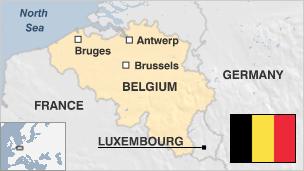
For such a small country, Belgium has been a major European battleground over the centuries.
Occupied
by Germany during the First and Second World Wars, it has experienced
an economic boom in the past 50 years to become a model Western European
liberal democracy.
However, there has also been a growing divide
between the mainly Dutch-speaking north and the mainly French-speaking
south, as well as concerns about the growth of Islamic extremism among
immigrant communities in the capital, Brussels.
Brussels is the
headquarters of the European Union and the North Atlantic Treaty
Organisation (Nato), making it the polyglot home of an army of
international diplomats and civil servants.
FACTS
Population 11.5 million
Area 30,528 sq km
Major languages Dutch, French
Life expectancy 79 years (men), 84 years (women)
Currency euro
Major religion Christianity
GETTY IMAGES
LEADERS
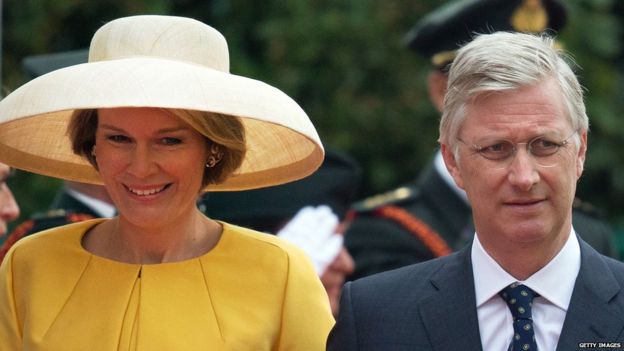
Image copyrightGetty ImagesMonarch: King Philippe
King
Philippe succeeded to the throne in July 2013 on the abdication of his
father, the 79-year-old Albert II, who stepped down on health grounds.
Respect
for the monarchy is one of the few factors that crosses the communal
divide in Belgium, and King Albert exercised his constitutional
authority in advising political leaders on the formation of a government
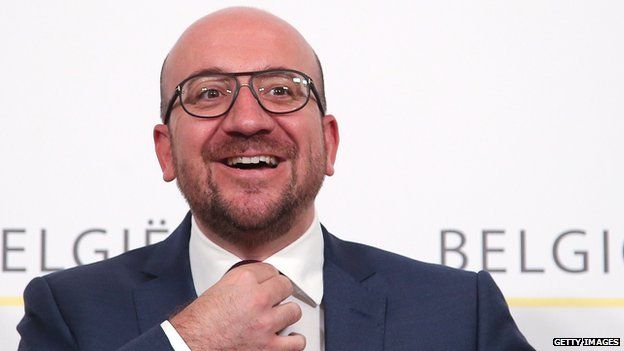
during the 2010-2011 parliamentary stalemate. Prime minister: Charles Michel Image copyrightGetty ImagesFollowing elections, Reform Movement leader Charles
Michel formed a right-wing coalition in October 2014, becoming at 38 the
country's youngest prime minister since 1841.
His liberal party
comes from the French-speaking community, but the other three parties in
the coalition represent Flemish speakers - including the nationalist
New Flemish Alliance (N-VA), which came first in the elections.
MEDIA
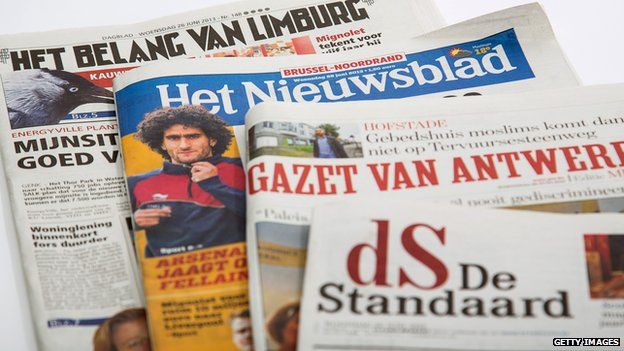
Image copyrightGetty ImagesBelgian broadcasting mirrors the unique political
and linguistic nature of the country. The cultural communities, rather
than the federal authorities, are responsible for regulating radio and
TV.
TIMELINE
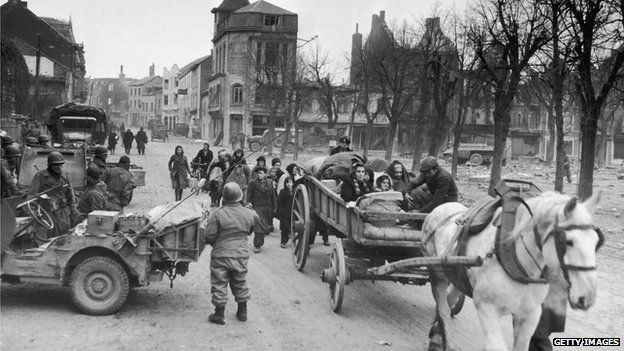
Some key dates in Belgium's history: 1830 - Declaration of independence from Netherlands. 1914-18 First World War - Occupied by Germany. 1940-45 Second World War - German occupation. 1993 - Constitution changed to recognise division of country into three administrative regions: Flanders, Wallonia and Brussels. 2002 - Euro replaces Belgian franc. 2016 March - Islamic State suicide bombers kill 35 people in attacks on Brussels. Image copyrightGetty ImagesImage caption
Belgians take flight during World War 2
Declaration on the Granting of Independence to Colonial Countries and Peoples
Adopted by General Assembly resolution 1514 (XV) of 14 December 1960
The General Assembly,
Mindful
of the determination proclaimed by the peoples of the world in the
Charter of the United Nations to reaffirm faith in fundamental human
rights, in the dignity and worth of the human person, in the equal
rights of men and women and of nations large and small and to promote
social progress and better standards of life in larger freedom,
Conscious
of the need for the creation of conditions of stability and well-being
and peaceful and friendly relations based on respect for the principles
of equal rights and self-determination of all peoples, and of universal
respect for, and observance of, human rights and fundamental freedoms
for all without distinction as to race, sex, language or religion,
Recognizing
the passionate yearning for freedom in all dependent peoples and the
decisive role of such peoples in the attainment of their independence,
A
ware of the increasing conflicts resulting from the denial of or
impediments in the way of the freedom of such peoples, which constitute a
serious threat to world peace,
Considering the important role of
the United Nations in assisting the movement for independence in Trust
and Non-Self-Governing Territories,
Recognizing that the peoples of the world ardently desire the end of colonialism in all its manifestations,
Convinced
that the continued existence of colonialism prevents the development of
international economic co-operation, impedes the social, cultural and
economic development of dependent peoples and militates against the
United Nations ideal of universal peace,
Affirming that peoples
may, for their own ends, freely dispose of their natural wealth and
resources without prejudice to any obligations arising out of
international economic co-operation, based upon the principle of mutual
benefit, and international law,
Believing that the process of
liberation is irresistible and irreversible and that, in order to avoid
serious crises, an end must be put to colonialism and all practices of
segregation and discrimination associated therewith,
Welcoming the
emergence in recent years of a large number of dependent territories
into freedom and independence, and recognizing the increasingly powerful
trends towards freedom in such territories which have not yet attained
independence,
Convinced that all peoples have an inalienable right
to complete freedom, the exercise of their sovereignty and the
integrity of their national territory,
Solemnly proclaims the necessity of bringing to a speedy and unconditional end colonialism in all its forms and manifestations;
And to this end Declares that:
1.
The subjection of peoples to alien subjugation, domination and
exploitation constitutes a denial of fundamental human rights, is
contrary to the Charter of the United Nations and is an impediment to
the promotion of world peace and co-operation.
2. All peoples have
the right to self-determination; by virtue of that right they freely
determine their political status and freely pursue their economic,
social and cultural development.
3. Inadequacy of political,
economic, social or educational preparedness should never serve as a
pretext for delaying independence.
4. All armed action or
repressive measures of all kinds directed against dependent peoples
shall cease in order to enable them to exercise peacefully and freely
their right to complete independence, and the integrity of their
national territory shall be respected.
5. Immediate steps shall be
taken, in Trust and Non-Self-Governing Territories or all other
territories which have not yet attained independence, to transfer all
powers to the peoples of those territories, without any conditions or
reservations, in accordance with their freely expressed will and desire,
without any distinction as to race, creed or colour, in order to enable
them to enjoy complete independence and freedom.
6. Any attempt
aimed at the partial or total disruption of the national unity and the
territorial integrity of a country is incompatible with the purposes and
principles of the Charter of the United Nations.
7. All States
shall observe faithfully and strictly the provisions of the Charter of
the United Nations, the Universal Declaration of Human Rights and the
present Declaration on the basis of equality, non-interference in the
internal affairs of all States, and respect for the sovereign rights of
all peoples and their territorial integrity.
Blog and Tweet20/2018Who doesn’t want
Independent Sarawak?
Besides
traitors, who doesn’t want Independent Sarawak?
Besides
traitors, who wants Sarawak to be so debased and degraded to be called a state
in the Federation of Malaysia?
Besides traitors,
who doesn’t want Sarawak to quite from the federation of Malaysia?Sarawak, after all, was a trust territory, in
the federation of Malaysia when we were not able to manage ourselves,
administratively, legislatively, executively.
Despite
the protests from various quarters, less than 10% of Sarawakians gave their
consent to join the federation of Malaysia but people were roped in on 16th
September, 1963 so much to the frustration and disappointment of the
majority.Knowing that it was just the transfer
of the colonial power from the Britian government to the Malaya
government.So, it is true and hence we
have been colonised since.Though the
United Nations declared decolonization on 14th December, 1960, we
were oblivious that we were actually colonised until some NGOs talked it.
We people
knew that we had been treated unfairly in the federation but we were aware that
we were colonised and we have the rights to quite from the federation of
Malaysia for good.Now more and more and
more and more and more…………………………. Sarawakians know what MA63 and United Nations
all about.
It is the
awareness that makes us realise that Sarawak is a country in the federation of
Malaysia and it is unconstituation and a breach of trust to lure the Sarawak
traitors to sign Petroleum Development Act in 1974 and to sign another
agreement to turn Sabah and Sarawak into 12th and 13th
state respectively.Since then they have
plundered, exploited and robbed us at will with the blessings of these
traitors.
Sarawak
has such a rich petroleum reserve ranking world No. 3 or 4 and yet we get so
little back for ourselves.It is only 5%
royalty.PH manifestoes promised to give
back, 20% but they are not willing to do so.This, no doubt, has made many
Sarawakians furious.We have endured
X-BN for 44 years plus for this discrepancy of5% Sarawak: 95% Malaya colonial powers.
For PH
government, we helped them to get rid of X-BN federal government with their
promise to give back 20% though we owns 100% of the rights of the resource.
Now
Sarawakians have set our minds to quit from the federation of Malaysia for good
so that we can own 100% of these natural resources like petroleum and natural
gas.
It is
also the time for us to get back all kinds of taxes collected by our Malaya
colonial power.They rob us of stamp
duty, income tax, ……. and they have many execuses to allocate funds for us for
different forms of development.We have lapsed so much behind.Why shall we subject ourselves to this
unfair, unkind and biased treatment when they rely 70% on our resources for
their income.Often the colonial
masters say that they will treat us fairly.Now we people ask why we need them to use our wealth to treat us
fairly.What kind of logic is it?
Now,
Sarawakians, I say, more and more have realized the fact that we can vote out
of the federation of Malaysia for good.We have set our minds to exit from the federation of Malaysia which we
have had ‘Lose – Win’ since 1963.What
is the point to stay in the federation?This is the question which every Sarawakian asks.
Yes, the
United Nations have given the colonised territories the rights of
Self-determination to quite from the colonial powers.Hence, I see 100 declare independence in the
late 50 years.The internet webpages
have the detailed records of these happenings.
Exiting
from the federation of Malaysia, all Sarawak has to do is complete the
procedure in the process:MA63 – Trust Territory
– Autonomy (hijacked) – Self-determination
KUCHING,
Sept 8: Former Padungan assemblyman Dominique Ng and at least six other
Sarawakian lawyers will file a lawsuit against the federal government
before the end of this year in an attempt to reclaim Sarawak’s rights as
enshrined in the Malaysia Agreement 1963 (MA63).
Ng told
DayakDaily that this legal team, which will include former Batu Lintang
assemblyman Voon Lee Shan, would be representing the people of Sarawak
to fight for Sarawak’s rights, which have eroded over the years.
“We
are now drafting our case to sue the federal government to take back
Sarawak’s rights, including oil and gas, and all other rights that
Sarawakians are now demanding.
“It will not just be oil and gas but the whole range of rights that have been violated and taken away from Sarawak,” said Ng.
Ng disclosed that all the lawyers involved in this case would be working on a pro bono basis.
“We
are tired of politicians who just talk and don’t follow up their talk
with action. For us, we just put everything into action.
“This is
because only by the action of a direct legal challenge to the federal
government may initiate some changes,” reckoned Ng.
He added that his team would bring the case to the Federal Court first, and then proceed from there.
“It
will be much cheaper if we pursue the case in Malaysia first. Only when
we have run out of options then we will pursue the case
internationally, which will be very expensive.
“Getting the case
heard in the United Kingdom is an option, and many are talking about it.
It will remain as an option until we exhaust all avenues,” Ng
explained. — DayakDaily