Finnish and Japanese graduates are likely to be higher performers than Brits, new analysis suggests Getty Images
British graduates are falling behind their Japanese,
and European counterparts, a new analysis of student performances from
across the world has revealed.
England and the United States may have dominated this year’s
top university rankings, but test results published by the Organisation
for Economic Co-operation and Development (OECD) suggests their
graduates’ literacy skills do not match up.
ADVERTISING
Taking into account a range of factors, including reputation
and research output, the QS World University Rankings for 2016-17 named
the Massachusettes Institute of Technology, Stanford and Harvard and as
the best institutions worldwide.
Read more
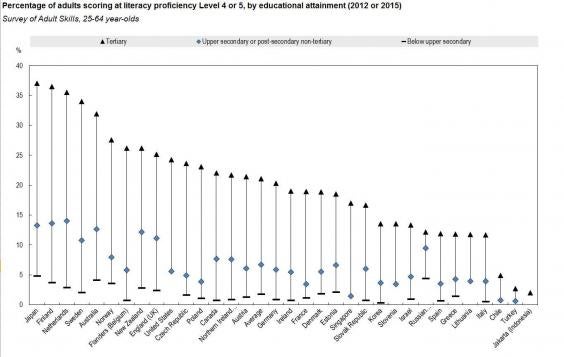
In a list of 35 OECD countries, however, the US comes in
ninth place, behind England in eighth place for advanced literary
skills.
According to the analysis, published in the OECD’s Education at a Glance
report, Japan is host to the most high-flying graduates, with Finland
in second place. Australia and New Zealand also top England and the US
in terms of ability.
Finland and Japan also come top in the OECD’s PISA rankings, compare secondary school standards around the globe.
Scotland and Wales are not included in the table, but Northern Ireland is marked at 14th place.
(OECD 2016)
South Korea and Singapore, both known for their high-achieving schools, also fall below average in the OECD graduate rankings.
The figures suggest that university reputation may not necessarily reflect student ability or graduate prospects.
Andreas Schleicher, the OECD's education director, says the
results show ability levels can “vary hugely among people with similar
qualifications”.
They might all have degrees, but “there are major differences in the quality of higher education”.
“When it comes to advanced literacy skills, you might be
better off getting a high school degree in Japan, Finland or the
Netherlands than getting a tertiary degree in Italy, Spain or Greece,”
he told the BBC.
According to the report, only 12 out of 35 OECD countries
with available data meet the benchmark for half of the Sustainable
Development Goal targets for education.
Finland and Japan also come top in the OECD’s PISA rankings, compare secondary school standards around the globe.
Some 36 per cent of today’s young adults are expected to
graduate before the age of 30, but only 41 per cent of full-time
bachelor students graduate within the theoretical duration.
The OECD list of top 10 highest performing graduates
1. Japan
2. Finland
3. Netherlands
4. Australia
5. Norway
6. Belgium
7. New Zealand
8. England
9. United States
Every year, the World Economic Forum releases its Global Competitiveness Report on the state of the world's economies.
The WEF looks at data on areas as varied as the soundness of
banks to the sophistication of businesses in each country. It then uses
the data to compile a picture of the economy of almost every country on
earth.
Countries were ranked according to the "12 pillars of
competitiveness," which includes macro-economic environment,
infrastructure, health and primary education, and labour market
efficiency.
We have drilled down into the schooling data to look at
which countries have the best education systems. Neither the US or the
UK make the grade in the top 11 (3 countries are tied for 9th, making 11
the clearest cut off point.)
Here are the ones that did make the grade:
=9. Japan: 5.6
Japan is one of the top performing countries for literacy,
science, and maths in the OECD group. Students go through six years of
elementary school, three years of junior high school, and three years of
high school before deciding whether they want to go to university. High
school is not compulsory but enrolment is close to 98%.
=9. Barbados: 5.9
The Barbados government has invested heavily in education,
resulting in a literacy rate of 98%, one of the highest in the world.
Primary runs from 4 to 11, with secondary 11 to 18. The majority of
schools at both levels are state-owned and run.
=9. New Zealand: 5.6
Primary and secondary education in New Zealand runs from
aged 5 to aged 19, with school compulsory between 6 and 16. There are
three types of secondary schools in New Zealand: state schools educate
approximately 85% of students, state-integrated schools — private
schools that have been integrated into the state but keep their special
charter — educate 12%, and private schools educate 3%.
8. Estonia: 5.7
Estonia spends around 4% of its GDP on education, according
to 2015 figures. The country's 1992 Education Act says that the goals of
education are "to create favourable conditions for the development of
personality, family and the Estonian nation; to promote the development
of ethnic minorities, economic, political and cultural life in Estonia
and the preservation of nature in the global economic and cultural
context; to teach the values of citizenship; and to set up the
prerequisites for creating a tradition of lifelong learning
nation-wide."
=6. Ireland: 5.8
The majority of secondary schools in Ireland are privately
owned and managed but state-funded, but there are also state
comprehensives and vocational schools. However, a recent report shows
that Ireland's spending on education fell 15% behind the developed world
during the height of the financial crisis, 2008 to 2013, suggesting its
education system could suffer in future.
=6. Qatar: 5.8
The BBC reported in 2012 that oil-rich Qatar was "becoming
one of the most significant players in the field of education
innovation, supporting a raft of projects from grassroots basic literacy
through to high-end university research." The country is investing
heavily in improving educational standards as part of its Vision 2030
programme to make the country self-sufficient. Government-funded schools
offer free education but only to Qatari citizens and most foreign
nationals tend to send their children to private schools.
5. Netherlands: 5.9
Dutch children were found to be the happiest in the world in
a 2013 Unicef study, leading the way globally educational well-being
among others. Schools typically don't give much homework until secondary
level and students report little pressure and stress. Schools are
divided between faith schools and "neutral" state schools, with only a
small number of private schools.
(Getty)
4. Singapore: 6.1
Singapore scores incredibly highly in the PISA (Programme
for International Student Assessment) tests, which aim to measure and
compare the performance of students across different countries. However,
the school system also has a reputation as being a pressure cooker,
putting students under a lot of stress at a young age.
=2. Belgium: 6.2
Belgium has four different genres of secondary schools,
namely general secondary schools, technical secondary schools,
vocational secondary education schools, and art secondary education
institutions. The Fulbright Commission in the US, which organises
student exchanges with Belgium and Luxembourg says: "Education enjoys
high priority, and the largest share of the regional governments’ annual
budget in Belgium. Complete systems of public and private schools are
available to all children between the ages of 4 and 18, at little or no
cost."
=2. Switzerland: 6.2
Just 5% of children attend private schools in Switzerland.
Lessons are taught in different languages depending on the region of
Switzerland, with German, French or Italian the most common languages of
instruction. From secondary onwards students are separated by ability.
1. Finland: 6.7
Finland routinely tops rankings of global education systems
and is famous for having no banding systems — all pupils, regardless of
ability, are taught in the same classes. As a result, the gap between
the weakest and the strongest pupils is the smallest in the world.
Finnish schools also give relatively little homework and have only one
mandatory test at age 16.
(Getty Images)
Finland schools: Subjects scrapped and replaced with 'topics' as country reforms its education system
With Finland radically reforming the way its children are
taught, Richard Garner visits Helsinki to find out if the teachers
approve
Pupils at Siltamaki primary school perform a rap as part of their cross-subject learning Jussi Helttunen
For years, Finland has been the by-word for a
successful education system, perched at the top of international league
tables for literacy and numeracy.
Only far eastern countries such as Singapore and China
outperform the Nordic nation in the influential Programme for
International Student Assessment (PISA) rankings. Politicians and
education experts from around the world – including the UK – have made
pilgrimages to Helsinki in the hope of identifying and replicating the
secret of its success.
Which
makes it all the more remarkable that Finland is about to embark on one
of the most radical education reform programmes ever undertaken by a
nation state – scrapping traditional “teaching by subject” in favour of
“teaching by topic”.
“This is going to be a big change in education in Finland
that we’re just beginning,” said Liisa Pohjolainen, who is in charge of
youth and adult education in Helsinki – the capital city at the
forefront of the reform programme.
Pasi Silander, the city’s development manager, explained:
“What we need now is a different kind of education to prepare people for
working life.
“Young people use quite advanced computers. In the past the
banks had lots of bank clerks totting up figures but now that has
totally changed.
“We therefore have to make the changes in education that are necessary for industry and modern society.”
Subject-specific lessons – an hour of history in the
morning, an hour of geography in the afternoon – are already being
phased out for 16-year-olds in the city’s upper schools. They are being
replaced by what the Finns call “phenomenon” teaching – or teaching by
topic. For instance, a teenager studying a vocational course might take
“cafeteria services” lessons, which would include elements of maths,
languages (to help serve foreign customers), writing skills and
communication skills.
More academic pupils would be taught cross-subject topics
such as the European Union - which would merge elements of economics,
history (of the countries involved), languages and geography.
There are other changes too, not least to the traditional
format that sees rows of pupils sitting passively in front of their
teacher, listening to lessons or waiting to be questioned. Instead there
will be a more collaborative approach, with pupils working in smaller
groups to solve problems while improving their communication skills.
Marjo Kyllonen, Helsinki’s education manager – who will be
presenting her blueprint for change to the council at the end of this
month, said: “It is not only Helsinki but the whole of Finland who will
be embracing change.
“We really need a rethinking of education and a redesigning
of our system, so it prepares our children for the future with the
skills that are needed for today and tomorrow.
“There are schools that are teaching in the old fashioned way which was
of benefit in the beginnings of the 1900s – but the needs are not the
same and we need something fit for the 21st century.”
The reforms reflect growing calls in the UK – not least from
the Confederation of British Industry and Labour’s Shadow Education
Secretary Tristram Hunt – for education to promote character,
resilience and communication skills, rather than just pushing children
through “exam factories”.
But there would currently be little appetite in the UK for going as far as ditching traditional subjects.
Even in Finland, the reforms have met objections from
teachers and heads – many of whom have spent their lives focusing on a
particular subject only to be told to change their approach.
Ms Kyllonen has been advocating a “co-teaching” approach to
lesson planning, with input from more than one subject specialist.
Teachers who embrace this new system can receive a small top-up in
salary.
About 70 per cent of the city’s high school teachers have
now been trained in adopting the new approach, according to Mr Silander.
“We have really changed the mindset,” he said. “It is quite
difficult to get teachers to start and take the first step… but teachers
who have taken to the new approach say they can’t go back.”
Early data shows that students are benefiting too. In the
two years since the new teaching methods first began being introduced,
pupil “outcomes” – they prefer that word to standards – have improved.
Finnish schools are obliged to introduce a period of
“phenomenon-based teaching” at least once a year. These projects can
last several weeks. In Helsinki, they are pushing the reforms at a
faster pace with schools encouraged to set aside two periods during the
year for adopting the new approach. Ms Kyllonen’s blueprint, to be
published later this month, envisages the reforms will be in place
across all Finnish schools by 2020.
Meanwhile, the pre-school sector is also embracing change
through an innovative project, the Playful Learning Centre, which is
engaged in discussions with the computer games industry about how it
could help introduce a more “playful” learning approach to younger
children.
“We would like to make Finland the leading country in terms
of playful solutions to children’s learning,” said Olavi Mentanen,
director of the PLC project,
The eyes of the education world will be upon Finland as it
opts for change: will it be able to retain or improve its showing in the
PISA league tables published by the Organisation for Economic
Co-operation and Development.
If it does, how will the rest of the education world react?
Case study: Finnish approach
It is an English lesson, but there is a map of continental
Europe on the whiteboard. The children must combine weather conditions
with the different countries displayed on the board. For instance, today
it is sunny in Finland and foggy in Denmark. This means the pupils
combine the learning of English with geography.
Welcome to Siltamaki primary school in Helsinki – a school
with 240 seven- to 12-year-olds – which has embraced Finland’s new
learning style. Its principal, Anne-Mari Jaatinen, explains the school’s
philosophy: “We want the pupils to learn in a safe, happy, relaxed and
inspired atmosphere.”
We come across children playing chess in a corridor and a
game being played whereby children rush around the corridors collecting
information about different parts of Africa. Ms Jaatinen describes what
is going on as “joyful learning”. She wants more collaboration and
communication between pupils to allow them to develop their creative
thinking skills.
The new curricula in a nutshell
The new curricula have been introduced - how is basic education reformed?
The
new curricula for compulsory basic education are implemented in all
municipalities and schools as of 1 August 2016. The Finnish National
Board of Education introduced the National Core Curriculum in 2014, and
the municipalities have drawn up their own local curricula based on the
national framework.
The National Core Curriculum provides a uniform foundation for local
curricula, thus enhancing equality in education throughout the country.
The curricula of each municipality and school steer instruction and
schoolwork in more detail, taking local needs and perspectives into
consideration.
Goal: to secure the necessary knowledge and skills as well as to encourage learning
The curriculum reform aims at ensuring that the knowledge and skills of
Finnish children and youths will remain strong in the future, both in
national contexts as well as international. In addition, pedagogical
guidelines have been outlined to help schools develop their operating
methods in order to increase the pupils' interest in learning and
motivation to learn.
Some of the key goals of the reform include enhancing pupil
participation, increasing the meaningfulness of study and making it
possible for each and every pupil to experience success. Children and
youths are guided in assuming more responsibility for their schoolwork,
but, in accordance with this, also given more support in their studies.
The pupils set goals, solve problems and assess their learning based on
set targets. The pupils' experiences, feelings, areas of interest and
interaction with others lay the foundation for learning. The teacher's
task is to instruct and guide the pupils into becoming lifelong
learners, by taking the individual learning approaches of each pupil
into consideration.
Learning outside the classroom and by using technology
One particular aim of the reform was to develop the learning
environments and work methods used in basic education. A learning
environment should be secure, and it should inspire learning. In
addition to the classroom and the immediate school environment, also
other environments, , such as getting out into nature or visiting
museums or businesses, should be used. Games and other virtual
environments should also be recognized more often as learning
environments. Technology plays an increasingly significant role in
everyday school routines, thus allowing pupils to be more easily
involved in the development and selection of their own learning
environments. Each subject at school uses a variety of work methods,
giving the pupils chances to learn different skills with each work
method.
Changes in distribution of lesson hours and subject contents
The Basic Education Act specifies the subjects taught and the
distribution of lesson hours. For example, social studies and languages
are introduced in a lower grade than before. The goals and contents of
the subjects have been updated to reflect today's society and the
knowledge and skills needed in the future.
Transversal competences developed in all subjects
The new curriculum places an emphasis on transversal competences in the
instruction of subjects. These competences are based on different
perspectives. Study, working life and active citizenship require a
command of different knowledge and skills as well as competences in
combining these. Each subject promotes transversal competence skills.
The aims set for transversal competences include thinking and
learning-to-learn, interaction and expression skills, and multiliteracy,
which is the ability to produce and interpret diverse texts.
Transversal competences also include managing daily life and taking care
of oneself. Other aims of transversal competences are ICT competence,
working life competence and entrepreneurship as well as social
participation and influence.
The aims of transversal competences are specified in the National Core
Curriculum, and municipalities and schools have been able to further
define the competences according to their individual areas of emphasis.
Familiarisation with the fundamentals of programming
Opportunities for pupils to develop their information and communication
technology skills have been improved in all subjects, with technology
being included more in instruction and study. For example, programming
has been integrated in the curriculum as part of the objectives set for
mathematics. Pupils learn the fundamentals of programming even in the
lower grades.
At least one multidisciplinary learning module a year
Each school year, every school must have at least one clearly defined
theme, project or course that combines the content of different subjects
and deals with the selected theme from the perspective of several
subjects. These entities are called multidisciplinary learning modules.
Pupils participate in planning the multidisciplinary learning modules at
their school.
Optional subjects at an earlier stage
More in the way of optional subjects has been made available to lower
grades. In addition, artistic and practical subjects also include
optional studies. Municipalities and schools decide on the optional
lesson hours in artistic and practical subjects, as well as the optional
subject content and placement for different grades.
Diversity in learning assessment
The new curriculum emphasises diversity in assessment methods as well
as assessment that guides and promotes learning. Information on each
pupil's study progress must be given to the pupil and guardians on a
sufficiently frequent basis. Feedback is given in ways other than report
cards.
At the end of each school year, pupils still receive a school year
report, which gives a grade for each subject on how well the pupil has
achieved the targets set for the school year. The municipality decides
as to whether the school year reports for grades 1-7 are verbal
assessments or numerical grades. However, numerical grades must be given
for every subject in the school year report by no later than the 8th
grade.
In order to ensure equality in assessment, national assessment criteria
for a numerical grade 8, meaning good performance, have been defined in
the National Core Curriculum in every subject for two major transition
phases. The first one is at the end of the 6th grade, the second one at
the end of the 9th grade. The assessment criteria describe, for each
subject, what kind of competence is required for good performance (grade
8). Each teacher uses these national criteria when assessing his/her
pupils for the purpose of reporting on the pupil’s knowledge and skills
in the school year report card for 6th grade and 9th grade, the latter
one constituting the basic education certificate.
Familiarisation with the curriculum of one's own school is key
The curricula of municipalities and schools specify the guidelines for
future learning and schoolwork. Each pupil has the right to receive
instruction in accordance with the curriculum on each and every day of
school.
All guardians should familiarise themselves with the curriculum of
their child's school. This makes it possible for the guardian to more
effectively support their child's learning and school-going as well as
participate in the planning and development of school activities
together with the school faculty.
Co-operation between home and school improves the well-being and safety
of the pupil, the class and the entire school community. Functional
co-operation is the key to building a successful school path for each
pupil.