Pages

Powered By Blogger

Wednesday, 4 April 2018

freemalaysiatoday.com

What next for Sarawak, Petros and Petronas?

FMT
Petronas and the federal government’s take from Sarawak’s petroleum has been around 91%, with Sarawak only getting 1%-2%.
By Suarah Petroleum Group
         SPG congratulates the Sarawak government and Chief Minister Abang Johari Openg for taking this bold and brave step to exert Sarawak’s ownership and its rights over its own petroleum resources.
         All Sarawakians must support this revolutionary move, as it immediately gives tangible hope for the equitable redressing of economic imbalances faced by Sarawak from the uneven distribution of economic value creation and subjection to unfair exploitation policies/practices on its rich oil and gas natural resources.
With the official launch of Petros on March 6 by the chief minister, followed by his unequivocal assertion that the ownership of Sarawak’s oil and gas resources still lies with Sarawak, all parties involved in the industry in Malaysia, especially Petronas, must accept this new reality.
       To avoid any doubt, it is no longer “business as usual”. The Sarawak government officially no longer recognises the Petroleum Development Act 1974 (PDA74) that unconstitutionally vested Sarawak’s petroleum resources with Petronas.
       So, what must come after this watershed moment for Sarawak?

New licensing and regulatory regime
        Following the chief minister’s announcement, a new licensing and regulatory regime will be imposed by the Sarawak government on July 1. It will detail the applicable rules and regulations applicable to bona fide players in the upstream, midstream and downstream sectors of Sarawak’s oil and gas industry. Even Petronas will have to apply for a licence to operate in Sarawak and will no longer be able to claim ownership of Sarawak’s petroleum resources.
       Petronas’ statement that it welcomes the formation of Petros within the current framework of PDA74 (reported in The Borneo Post, March 8) appears in denial of the new reality.   There is broad expectation among Sarawakians from all walks of life that Petronas will accept the new rules of the game after more than 40 years of having things their way.  The sooner the better for all, and it will be a reflection of the maturity and professionalism of Petronas’ current leadership team.

Sarawak petroleum authority
         To ensure that proper management and governance is in place to safeguard the state’s resources and its environment, the Sarawak government should without delay set up the Sarawak Petroleum Authority, reporting directly to the chief minister or perhaps to a newly created energy ministry, with full power and authority to control and regulate all aspects of the petroleum industry in Sarawak.
       This is to avoid further depletion of its resources with poor value creation. For example, Petronas’ National Gas Utilisation policy states that the gas resources in Sarawak and Sabah are mainly for export whereas for the peninsula it is for domestic energy and industrial consumption. To make matters worse, it is even subsidised at the expense of re-investment for economic multiplier projects in Sabah and Sarawak.
       As can be surmised, the so-called massive profits from Bintulu LNG operations and offshore Sarawak have been at the ultimate expense of better value creation of its economy.  This is a sacrifice which was forced on Sarawak to fuel the economic boom in Malaya from Petronas’ Peninsular Gas Utilisation (PGU) project.  Therefore, such a policy must be changed for better value-creation covering Sabah and Sarawak, in the interest of a truly national and balanced development within Malaysia.

Sarawak oil and gas fiscal and planning framework
       The Sarawak government will need to decide what fiscal framework to impose on Petronas and all other operators within Sarawak’s boundaries.  It is suggested that the Production Sharing Contract (PSC) regime adopted by Petronas itself would be an appropriate model to follow, given its success in bringing Petronas to where it is today.
       Most importantly, Sarawak must be able to craft its own strategic policy and values of having control and ownership of its oil and gas resources, aimed at promoting the best utilisation and value creation from Sarawak’s resources. These policies and values will underpin the terms and conditions of, among others, the fiscal regime, procurement policies and giving priority to Sarawak companies.

Sarawak petroleum development master plan
      It is also timely for the Sarawak government to formulate its own petroleum development master plan (something that has not been done holistically) covering key areas of upstream, midstream and downstream development, to ensure an orderly and sustainable development of the industry, which at best has only a 15- to 20-year window of opportunity before it is overtaken and replaced by renewable energy.

Handing over of Sarawak’s oil and gas assets by Petronas
       Petronas’ role in all new and existing PSCs must be relinquished and, together with all of Sarawak’s oil and gas assets, handed over to the Sarawak Petroleum Authority.  Petronas (and its current operators) can continue operating the PSCs but only as a contractor to the Sarawak government with terms and conditions for the continued operations to be negotiated and agreed on.

Data acquisition
      In order to adequately exercise its ownership rights, the Sarawak government must require Petronas to hand over all existing exploration and production data to the Sarawak Petroleum Authority, which should be equipped to store, examine and complement such data.  After all, this data was taken over by Petronas from Shell, which had operated in Sarawak’s territory and waters since the 1900s.

New PSCs
    We note with concern that Petronas is still signing new PSCs with its contractors. There must be a moratorium on all new PSCs and all other related dealings in the interim period.
       Under the new rules, all PSCs for existing operating blocks in Sarawak must be regularised with the real owner (Sarawak) and signed by Petronas and all other operators with the Sarawak government represented by the Sarawak Petroleum Authority.
     The current 70:30 split between Petronas and its contractors after taking into account cost oil or cost gas should be reviewed since Petronas no longer functions as owner/regulator.

       Petros’ carried interest
      The Sarawak government must insist that Petros take up a stake (“carried interest”) in all new PSCs, similar to that given to Petronas Carigali. This is extremely important if it wants to build up Petros as its operating oil and gas arm.
All of this will constitute immediate revenue generation for the Sarawak government to replace the 5% cash payment currently made by Petronas (which may continue as partial credit towards the new revenue model).  The 5% now paid by Petronas to the federal government under PDA74 must stop insofar as Sarawak is concerned.  This can no longer be sustained with the repudiation of PDA74.
       Other than upstream in exploration and production, Petros should also look into active participation in the midstream and downstream sectors to take advantage of the full value chain of the petroleum business, especially as Sarawak will have access to its own production under the new PSCs.
        At the same time, the Sarawak government must look into tax-exempt status for Petros, which would otherwise be subject to corporate tax on its earnings as a company operating under the Companies Act.  This would defeat the purpose of having Petros as a cash-generating vehicle for the Sarawak government.

Audit of cash payments by Petronas to the Sarawak government
      Sarawak is said to owe the federal government RM2.5 billion.  SPG believes there are grounds to question the amount of revenue from the cash payments made by Petronas to Sarawak, which would appear have never been audited.  SPG also questions whether the excise and export duties for crude oil and petroleum products collected by the federal government have been remitted to Sarawak as required under the Federal Constitution.

Restitution and reparation
      Furthermore, in settlement and compensation for all its activities over the years under PDA74, all shares in companies and associated facilities based on Sarawak’s oil and gas resources operated by Petronas in Sarawak, such as MLNG and ABF, must be handed over to the Sarawak government.
       Some have said that it takes longer to develop a state as big as Sarawak. This ignores the fact that with proper allocation of its own oil and gas resources, Sarawak would definitely have been in a much better position economically and in terms of physical development than it is today.
      PDA74 may have created a “tuan tanah” or “landlord” mentality in Petronas, and has failed to give due consideration to producing states’ interests in the development of their petroleum resources.  Sarawak and Sabah could have been developed as twin hubs for gas/petrochemicals and oil respectively as they have the biggest reserves of these two resources.
       One only has to look at the current state of the facilities in Lutong, Miri, to have a sense that Petronas only wants to maintain a minimal presence while exploiting to the fullest the Miri light crude that now trades in place of Tapis crude from Malaya which has depleted.  Instead, new multi-billion ringgit investments are going to places where no indigenous oil and gas resources exist.

Redressing of economic imbalance
      The Sarawak government must stand firm and resolute in strategically addressing the situation and properly managing Sarawak’s petroleum resources for the benefit of present and future generations of Sarawakians.  Sarawakians, irrespective of their political beliefs, must stand with the government in this regard.
The economic imbalance between Malaya and Sarawak needs to be addressed, and Petronas needs to adjust to this economic reality.  It is ultimately in the national interest that both sides make sacrifices for each other, and not one way only.
History will show that Sarawak has contributed far more than its fair share to the nation’s economic growth, at the expense of its own needs.  Sarawak and its people cannot remain deprived of the real fruits of the management and development of their own petroleum resources.  Petronas and the federal government’s take from Sarawak’s petroleum has been around 91%, with Sarawak only getting 1%-2%. This has to change.
      In all federal systems throughout the developed world, states are never deprived of the benefit of their God-given resources, as federal coffers can be filled through many other avenues.

     Sarawak and Sarawakians deserve to be in the mainstream of Malaysia’s development. Now.  Suarah Petroleum Group is a think tank comprising Sarawakian professionals in the oil and gas industry.

The views expressed are those of the authors and do not necessarily reflect those of FMT.

Monday, 2 April 2018

Balingian school project yet to take off

        I failed to find the post to copy and paste. 
        "The proposed SMK Balingian project -- a by-election promise made in 2014 -- is yet to take off and the local residents are growing impatient." The Borneo post (31st March, 2018)
        The Balingian folk have been fooled.  Now the so-called national election is coming and so the BN political thugs are there to renew their promises again.  This reminds me of an electricity pole planted somewhere with the promise of electricity supply to the longhouse somewhere.  It was discovered that the pole was standing there for 40 over years without any actions.  So promises, I believe were renewed and renewed and renewed.........................through for so many times of election.
        The people are treated like fools and so they are fooled all the time.  I don't know when these people will wake up from many and many sweet promises and dreams created by these evil political thugs for the fools to dream on.

        Alamak! What a shame! What a pity!  What a curse!

Wednesday, 14 March 2018

STAR:State govt has finally realised Acts not relevant to S'wak
SIBU: State Re­form Party Sarawak ( STAR) says the state gov­er­ment has fi­nally awo­ken to the re­al­i­sa­tion that Petroleum De­vel­op­ment Act, 1974 (PDA) and the Ter­ri­to­rial Sea Act, 2012 (TSA) are not rel­e­vant to Sarawak as thay have not been ap­proved by the DUN, and there­fore void.
         Its president, Lina Soo, said the state govern­ment has now ad­mit­ted that Sarawak’s rights and ter­ri­to­rial in­tegrity had in­deed been scrapped by Acts of Par­lia­ment, which con­tra­vened Malaysia Agree­ment 1963, and by ex­ten­sion, the Sarawak Con­sti­tu­tion.
   “Since the PDA 1974 is un­con­sti­tu­tional in Sarawak, the the state govern­ment should im­me­di­ately in­struct Petronas to stop its op­er­a­tions in Sarawak,” she told a press con­fer­ence here on Satur­day.
        She said there should not be any new li­cences is­sued to Petronas, and if nec­es­sary, the state govern­ment must also con­sider court ac­tion to safe­guard its oil and gas re­sources.
        STAR sec­re­tary-gen­eral Si­mon Tiong and com­mit­tee mem­bers were also present at the press con­fer­ence.
        Soo was re­fer­ring to the re­cent state­mant made by Chief Minister Datuk Pat­inggi Abang Jo­hari Tun Openg that the Petroleum De­vel­op­ment Act 1974 ( PDA) and the Ter­ri­to­rial Sea Act 2012 (TSA) are not rel­e­vant in Sarawak.
        Both are fed­eral laws, and for any fed­eral law to be im­ple­mented in Sarawak, the Sarawak State Leg­isla­tive Assem­bly ( DUN) has to en­dorse them.  And, since the state DUN had not en­dorsed both laws, they could not be im­ple­mented or su­percede the state laws.
        Soo thus urged the DUN to pass two res­o­lu­tions in the May sit­ting, to firstly, re­ject PDA 1974, and sec­ondly, to re­ject TSA 2012, to for­malise the state govern­ment’s re­pu­di­a­tion of both Acts which are detri­men­tal to Sarawak in­ter­ests and ter­ri­to­rial in­tegrity.
        She also said that prime minister, if he is sin­cere to re­turn Sarawak’s rights, should al­low the pro­vi­son to be at­tached to PDA 1974 and TSA 2012 with the clause
     ‘This Act shall not ap­ply to Sarawak and Sabah’.
      “We are not pow­er­less. We have the MA63 to safe­guard our na­tional in­ter­ests, and we have the laws on our side, in­clud­ing our Oil Min­ing Or­di­nance and Gas Dis­tri­bu­tion Or­di­nance,” she added.
         Soo said the an­nounce­ment of the chief minister rings hol­low if the state govern­ment does not fol­low up the con­sti­tu­tional process to for­malise the restora­tion of our rights, re­sources and pow­ers which have been taken away.
      “Who then will is­sue the min­ing li­cence to Pet­ros, is it Petronas un­der the PM or the Sarawak govern­ment un­der our CM,” she asked.
          Soo also ques­tioned re­sponse from DAP and PKR on their neg­a­tiv­ity and dis­in­ter­est to fight for Sarawak rights per­tain­ing to the is­sue of own­er­ship of oil and gas found in our ter­ri­tory.
        She said it’s strange that Pakatan Sarawak should sub­mit to Malaya’s hege­mony by prop­a­gat­ing our oil and gas as be­long­ing to the fed­eral govern­ment by rec­om­mend­ing 20 per cent in the new deal, should they come into power.
      “Why not 100 per cent in recog­ni­tion of Sarawak’s own­er­ship of our min­er­als, and then we can ne­go­tiable from there.”
        Soo said no MPs had on record ob­jected to the pass­ing of TSA 2012 in Par­lia­ment in 2012.
       STAR be­lieves that the PDA 1974 is un­con­sti­tu­tional, which has wrong­fully as­sumed own­er­ship of our oil and gas.
“   STAR fights for 100 per cent con­trol and own­er­ship of our re­sources and po­lit­i­cal bound­aries in­clud­ing our con­ti­nen­tal shelf and wa­ters.”
       Soo said this un­con­sti­tu­tional process of pass­ing through Acts of Par­lia­ment with­out ac­quir­ing con­sent from Sarawak DUN must cease-and- de­sist.
    “The state govern­ment and the op­po­si­tion ought to be vig­i­lant and serve the peo­ple with due dili­gence and deep com­mit­ment to safe­guard what be­longs to Sarawak.”

Tuesday, 13 March 2018

theborneopost.com

The ‘cost’ of seeking treatment

Jude Toyat, reporters@theborneopost.com

Patients stand in line waiting to enter Miri Polyclinic, where they would then have to obtain a number and wait once more to see a doctor.

MIRI: Queues lasting hours and an even longer waiting period to see a doctor are proving to be the bane of the sick and the elderly seeking treatment at Miri Polyclinic.
        The near-daily scenario sees patients – some from as far as Bekenu – gather at the main gate as early as 4am in the hope of being among the first to obtain a queue number that would enable them to fulfil their medical needs earlier, meaning that they would then be able to return home early.
       The plight of these patients prompted Piasau assemblyman Datuk Sebastian Ting to make a visit to the polyclinic yesterday, following complaints of the monstrously long time it would take just to see a doctor.
   “The Miri Polyclinic implemented a new system on March 5. The new system allows the main gate to only open at 6am compared to 5am previously, due to the clinic’s official operating time, which does not start until 7.30am.
    “Despite the notice of this change (of gate opening time), patients still queue up in front of the gate from 5am onwards.  Numbers will only be issued to patients from inside the building, meaning that once the gate opens, we will see people rushing to come in (to get a number),” he said.
     Ting pointed out that patients from afar face an even longer wait, as they arrive at the clinic as early as 4am hoping to be able to fulfil their needs so that they would have ample time to make the subsequent trip home.
    “Some of these people are older than me and they are here because they are not well and in need of treatment.  Waiting for hours is very tiring even for a regular person, what more to say those who are unwell. It is not right for them to (have to) go through this,” he said.
       He stressed that he is committed to overcoming the long queues and waiting period at the polyclinic, and suggested that the clinic revert the opening time of its main gate back to 5am.
       He added that two Rela members would be stationed in front of the clinic’s main door starting today to give out queue numbers to avoid any confusion among patients.
       Ting said he is also looking to purchase a ticket-issuing machine soon to ease the scramble to obtain a waiting number.
     “The medical staff will give me the brand (of the machine) and where to order it. I would also like to express my empathy to the people of Miri who have had to go through this, and I will make sure this issue will soon be resolved.”
       Miri Polyclinic operates from 7.30am to 10pm on weekdays, and from 8am to noon on Saturdays. It remains open during lunch hours.
       A notice – posted on the clinic’s main door – informs that starting March 5, clinic services begin at 7.30am and that patients are to collect their queue number from a counter inside the clinic from 7.30am onwards.
       During Ting’s visit, a line of over 50 patients was seen leading to the clinic, where they would then have to obtain a queue number before waiting yet again to have their medical needs served. For the latecomers, that waiting period could last more than a few hours.
       Ting was accompanied by Miri Division Health officer Dr Veronica Lugah and several of the clinic’s staff members.

What do you think of this story?
  • Angry (74%)
  • Sad (25%)
  • Great (2%)
  • Nothing (0%)
  • Interesting (0%)

    My comments:
    Change the government for good.  When there is competition, there is progress.  Waiting in the long queue to get a number and then another long wait to see the doctor is a common scene in Sibu, too.   I believe, this scene is common everywhere in Sarawak or Sabah.  

    Personally, I brought a friend who needed an eye specialist to check her eyes .  She went through this ordeal.  She had to wait for a long time for the number to see the doctor at the polyclinic Sibu.  Then the doctor appointed her a date to see the specialist in Sibu General Hospital.  There we waited for at least 4 - 5 hours to see the specialist who attended to her for about 10 - 15 minutes most.  While waiting, I dozed off many times.  

    Alamat!  What a pity!  What a shame!  What a curse!  Many BN political thugs boast about RM 1 dollar to the doctor.  

    Lately, I have come across friends who complained to me that the doctor in Sibu General Hospital referred her to the private clinic when she sought treatment for her dry red sensitive hands the skin of which just cracked.  She is poor.  But she had to fork RM40 each time for treatment.

    Another case was that my friend was told that the medicine for treating epilepsy for son was out of stock so much to her dismay.  She was advised to buy it at the pharmacy in town.  But she could not find it, either.

    I believe that there are many and many similar cases like these.

    I believe the promised allocation funds for hospitals have never been fulfilled for years due to serious embezzlement in the whole system of the BN government.  It is reported that 40% of the allocation funds are embezzled.  I believe that more than 40 % have been embezzled.  Hence, we are told that the government has no money for the repair of the roads or installation of lamps along the roads to many areas or construction ....  

    Check if there are any road lamps after Salim water board.


Saturday, 10 March 2018

freemalaysiatoday.com

DAP: Sarawak must bring 2 Acts on oil and gas rights to court

FMT Reporters
Bukit Assek rep Irene Chang urges Sarawak CM Abang Johari to bring matter to state assembly for a vote on having federal laws declared null and void in court.
Bukit Assek assemblyman Irene Chang says Sarawak government must table bill in state assembly to challenge PDA and TSA in court.
PETALING JAYA: A Sarawak DAP leader says the only way for Sarawak Chief Minister Abang Johari Openg to redeem himself following his claim that the Petroleum Development Act 1976 (PDA) and the Territorial Sea Act 2012 (TSA) are null and void is by taking the issue to court.
Irene Mary Chang, who is Sarawak DAP director of women’s affairs’ bureau, said it was wrong of Johari to say that these two laws are not applicable in Sarawak anymore following his announcement on Tuesday that the state would assume full regulatory authority over the upstream and downstream aspects of the oil and gas industry in Sarawak.
“To declare these two legislations as null and void and therefore have no application in Sarawak, the CM has to first bring the matter before the Courts of Law for such a declaration.
“And until the Courts declare as such, the acts are in force and are applicable in Sarawak. To say otherwise is to give people false hope and the state government owes it to the people to set the matter right,” she said.
The Bukit Assek assemblywoman further questioned if the state government would do the right thing by taking the issue to the state legislative assembly to pass a motion to review the two Acts and thereafter to get a Court Order to declare them as null and void and are therefore not applicable in Sarawak.
“Does the state BN government have the political will to go up to the prime minister and the Federal Government to do this?
“Have they got the political courage to go up to their masters in the peninsula to tell them that since they believe that the Acts are not applicable, Petronas should immediately cease operation in Sarawak waters?
“Or are they just going to continue to allow Petronas and Putrajaya to continue swallowing up a major chunk of the revenues earned from our oil and gas and to accept a mere 5% royalty in return,” Chang asked.
She added that it was time for the state government to come clean and admit that they had allowed daylight robbery to be committed in Sarawak for the past 44 years.
“They need to prove their sincerity in claiming back what rightfully belongs to Sarawak.
“The state government might even have the legal right to demand for the return of all the revenues earned from the resources from 1974 until now,” she said.

My Comments:
When the court of justice is no longer just in practice, bringing the cases to the court may bring Sarawak into a trouble water.   Abuse of power and corruption are not allowed by the law but the political thugs just go ahead with the practice.  Many political thugs have built up mega ill-gotten wealth through illegal acts.

Now PDA and TSA were passed against the ruling of MA63.  Why should we bring the unconstitutional acts to court to set it right?  This is the question.  That is why Sarawak should go ahead with our rights as stipulated in MA63.
theedgemarkets.com

Cover Story: Why Sarawak questions the Petroleum Development Act

Khairie Hisyam Aliman
FOR over four decades, the Petroleum Development Act 1974 (PDA) has been the bedrock of Malaysia’s oil and gas landscape.

In a nutshell, it is the law that created Petroliam Nasional Bhd (Petronas) — Malaysia’s only Fortune 500 company — which is vested with the nation’s oil and gas wealth.

Now, Sarawak is questioning whether the Act is still valid. Chief Minister Datuk Patinggi Abang Abdul Rahman Zohari Abang Openg says it is a critical matter
Sarawak is actively pursuing.

The question hinges on the state of emergency under which the bill was passed in 1974, according to Abang Abdul Rahman Zohari, who is popularly known as Abang Johari.

To recap, days after the racial riots on May 13, 1969, the then Yang di-Pertuan Agong issued the Emergency Proclamation, applicable to the whole country. Parliament was suspended and the entire nation was placed under a caretaker government, led by the then deputy prime minister Tun Abdul Razak Hussein, until 1971.

While Parliament reconvened in 1970, the proclamation — along with two other emergency proclamations that applied to Sarawak and Kelantan — were never lifted until 2011.

That means the Petroleum Development Bill was passed while the nation was, technically, under a state of emergency.  In end-2011, Parliament revoked the three proclamations as the conditions that precipitated them — security and public order coming under threat — no longer existed.

Some parties have argued that the lifting of the proclamations means certain legislation, including the PDA, which was enacted using emergency powers, will cease to have effect.

“So, the question is, when the emergency was lifted, is (the PDA) [still] relevant? We don’t know. That’s what we have to discuss (with the federal government),” says Abang Johari.

He adds that Sarawak has formed a “high-level committee to [look into it] because we feel that it (the PDA) is not relevant anymore”. However, he stresses that it is for the legal minds from both sides to determine and “not for me to decide”.

The Sarawak government’s position on the issue is relatively new. Abang Johari’s immediate predecessor, the late Tan Sri Adenan Satem, had started the ball rolling by asking for higher oil royalties than the present 5% after becoming chief minister in 2014.

That year, the Sarawak legislative assembly, led by Adenan, unanimously passed a motion to ask for 20% oil royalty, a move originally mooted by the opposition. This marked a departure for Sarawak, which had not raised the issue for decades since the PDA was enacted.

In a book on Tengku Razaleigh Hamzah, An Unending Quest, by Ranjit Gill, the first Petronas chairman and the architect of the PDA recalls that the idea of setting up a national oil company originated from his discussions with Tun Razak in 1972.

Two years later, Tengku Razaleigh was tasked with setting up such a company, which would run on a commercial basis. Sarawak, as the nation’s largest oil producer at the time, had concerns on whether such an arrangement would benefit it.

Recalling conversations with the then Sarawak chief minister Tun Abdul Rahman Ya’kub, Tengku Razaleigh says in the book that Abdul Rahman eventually agreed to a national oil company, which would distribute profits equally to the federal government and Sarawak.

At a meeting just before the bill was tabled in Parliament, Tun Abdul Rahman again agreed to an arrangement where oil proceeds would accrue to the company, but both Sarawak and the federal government would get 5%, he says.

Tun Abdul Rahman was later replaced as chief minister by his nephew, Tun Abdul Taib Mahmud, who would go on to govern for 33 years, from 1981 to 2014.

It was only after Tun Abdul Taib stepped down, with Adenan succeeding him, that the question of royalty quantum became a talking point for the Sarawak government, which has always been part of the ruling Barisan Nasional coalition.

Should Sarawak succeed in arguing its case on the PDA issue, it could result in significant complications.

Data from the Energy Commission shows that as at end-2015, Sarawak possessed 28.7% of known national oil reserves and accounted for 29.4% of national production.  As for gas, Sarawak accounted for 52.7% of the country’s known reserves.

Today, Sarawak is said to hold much potential in terms of unexplored hydrocarbon deposits.

It is worth noting that a few months after Abang Johari took charge of Sarawak, he set up Petroleum Sarawak Bhd (Petros) to be Sarawak’s wholly owned oil and gas company.

He has said Petros should have equal standing with Petronas in terms of oil and gas activities in Sarawak.

Abang Johari tells The Edge that Petros will be an “active player” in the sector within two years, envisioning it to go into oil exploration, among other things.

It is important to note that some production sharing contracts in Sarawak are expiring around that time.  Abang Johari declines to comment on whether that is a factor behind the two-year deadline.

Should discussions with the federal government result in upholding the Sarawak government’s interpretation, is there a possibility that Petros will be vested with Sarawak’s oil and gas reserves?

“Yes, something like that,” Abang Johari says, adding that the ideal outcome should be a “win-win [situation] for the Sarawak and federal governments”.

The PDA issue is part of Sarawak’s pursuit of rights under the Malaysia Agreement 1963, which it says “have been eroded”. According to Abang Johari, one example of such rights is Sarawak’s claim to its territorial waters.

The Malaysia Agreement is an international treaty that was signed by the then Federation of Malaya, Sabah (then North Borneo), Sarawak, Singapore and the UK.

In essence, it led to Singapore, Sabah, Sarawak and Singapore gaining independence from Britain to form Malaysia with Malaya. Two years later, Singapore was ejected from the federation.

“When we formed Malaysia, our boundary was 12 nautical miles, but now, it is only three nautical miles,” says Abang Johari. “Under Article 2 of the Federal Constitution, you cannot change our boundary [without Sarawak’s consent].”

The chief minister is referring to the Territorial Sea Act 2012 (TSA), which limits a state’s claim to fisheries, marine and other resources to three nautical miles from the coastline.

While the Federal Constitution allows Parliament to alter a state’s boundary, such changes require the consent of the affected state as well as that of the Conference of Rulers.

To date, the Sarawak legislative assembly has yet to enact any laws accepting the changes under the TSA. In end-2015, it unanimously passed a motion to reject the TSA, among other things.

The TSA question ties back to Sarawak’s eye on its oil and gas wealth as hydrocarbon deposits in Malaysian waters mostly occur beyond the three-nautical-mile line.

To strengthen its case, Sarawak sent a legal team to London last year to do further research on the Malaysia Agreement and gather additional documentation on its rights under the treaty.

“We have found documents that strengthen our argument on our rights,” says Abang Johari, whose father Tun Abang Openg Abang Sapiee — Sarawak’s first governor — was among the signatories to the Malaysia Agreement.

He confirms that the documents found include the Sarawak (Alteration of Boundaries) Order 1954 by the Queen in Council, which stipulates that Sarawak’s boundaries include the seabed and subsoil beneath its territorial waters.

It raises a critical question from Sarawak’s perspective as the Sarawak Oil Mining Ordinance 1958 regulates oil production, both onshore and offshore, within its territory.

“The PDA does not exclude application of other written laws, including the Oil Mining Ordinance. Under the Federal Constitution, only Sarawak can issue mining leases for oil production,” opines one legal expert favouring Sarawak’s interpretation.

In layman’s terms, if the seabed beyond three nautical miles does belong to Sarawak, as argued by its government, Petronas would be required to obtain a mining lease to extract the oil and gas resources found there.

That scenario would shift the leverage substantially in favour of Sarawak. Abang Johari declines to comment on where he hopes the discussions will lead to insofar as Sarawak’s oil and gas resources are concerned.

“Let them (the legal team) discuss the legal implications, [it is] not for me to decide,” he says.

While the issues raised by the Sarawak BN government are valid, political observers question its timing as the 14th general election is due anytime now. The PDA has been there since 1974 and Sarawak itself has benefited not only from the royalties but also from the spin-offs of the oil and gas industry there.  Sarawak houses some of Petronas’ largest investments and in the MLNG plant in Bintulu, it has one of the largest liquefied natural gas facilities in the world.

Petronas is also well managed and its managers over the years have turned a company with a start-up capital of RM11 million into one with RM600 billion in assets, without the need for the shareholder — the federal government — to increase its investment in the company.

For there to be a change in Petronas’ role as the custodian of the country’s hydrocarbon resources, the PDA has to be amended. One peninsula-based political pundit believes that it will require a two-thirds majority in Parliament to effect it. Why didn’t Sarawak push for the change when BN had the numbers in Parliament between 1974 and 2004?

Friday, 9 March 2018

asklegal.my

5 Facts You Didn't Know About The Malaysia Agreement 1963

Shortly after the Federal Government's announcement of tourism tax that's slated to take effect in July, the Sarawak state government made a surprise move by withdrawing its state representative from the Malaysian Tourism Board with immediate effect.
This move is believed to be a result of Sarawak's request for the July implementation to be postponed to a later date, which was denied. But what's interesting is that Sarawak State Minister of Tourism Datuk Abdul Karim Rahman Hamzah said that tourism was a matter to be discussed as part of the Malaysia Agreement 1963:
“If they do not want to defer it in Semenanjung, that is up to them. But at least defer it in Sabah and Sarawak ... You have to respect the Malaysia Agreement 1963. And another thing ― the state government must have some say in the matter; maybe the state government wants part of the tax collected to be returned." - Datuk Abdul Karim Rahman Hamzah, as quoted by The Maiay Mail Online.

In even more recent news, current Sarawak Chief Minister Abang Johari Openg announced he was sending a team of lawyers to London to study details of the Malaysia Agreement:
"This agreement is not simply an agreement; we want to get the facts right because if we want to make a claim, we must do our homework, otherwise we are just shooting at the target without hitting it." - Abang Johari Openg, as quoted by Malaysiakini.
So.... what's the Malaysia Agreement all about?
As a quick refresher on what you read about in school textbooks, the Malaysia as we know it today was initially formed as the Federation of Malaya on 31st August 1957 in accordance with the Federation of Malaya Agreement:

"As from the thirty-first day of August, nineteen hundred and fifty-seven, the Malay States and the Settlements shall be formed into a new Federation of States by the name of ... the Federation of Malaya..."

However, this did not include Sabah and Sarawak. This inclusion actually came about later, when another agreement was signed which led to the merger between Sabah, Sarawak and, briefly, Singapore and the Federation of Malaya to form the present day Federation of Malaysia.
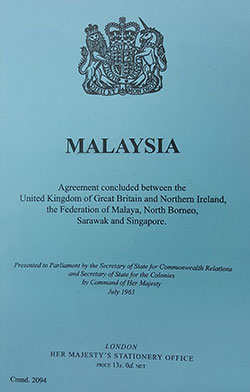
That agreement is the Malaysia Agreement 1963 (MA63), which set out the terms and conditions in which the three states agreed to merge the Federation of Malaya to form Malaysia:

Article 1, Malaysia Agreement 1963

"The Colonies of North Borneo and Sarawak and the State of Singapore shall be federated with the existing States of the Federation of Malaya as the States of Sabah, Sarawak and Singapore in accordance with the constitutional instruments annexed to this Agreement and the Federation shall thereafter be called Malaysia."
Aside from being the crux of the debate for greater autonomy for East Malaysia and (now) the tourism tax issue, the MA63 is a pretty fascinating document. For instance, did you know...

1. MA63 is an INTERNATIONAL agreement


Signatories of the Malaysia Agreement arriving in London on July 12, 1963. Image from The Borneo Post.MA63 is an international agreement, registered in the United Nations on 21 September 1970, bearing the registration number 10760. Being an international agreement, this means the Malaysia Parliament has no authority to amend the terms of MA63.


What the Parliament can do is pass new law to give legal effect to an international treaty. For example, the Parliament passed the Malaysia Act 1963 to give legal effect to MA63. Certain parts of the Federal Constitution have also been amended to incorporate the terms of agreement made between Sabah, Sawak and Malaya during the formation of Malaysia.

The Federal Constitution is said to have been amended over 700 times since 1957, but the terms contained within MA63 have remained unchanged since the day it was signed in 1963, as it is beyond the Parliament's jurisdiction to amend it.


2. Unlike Malaysian laws, MA63 cannot be changed in the Malaysian Parliament

The only way the terms within MA63 can be amended is for all the signatory parties to sit down together as peers and amend it.


This is due to the fact that MA63 is an international treaty, not a piece of law that the Parliament has legislated.As mentioned in the previous point, the Parliament has no legal right to amend an international treaty.

In practice this would mean Sabah, Sarawak, the federal government and the United Kingdom would have to sit together and renegotiate the terms in order to change it.
Unlike the Federal Constitution which can be amended by the Malaysian Parliament, MA63 and IGC Report can never be amended by anyone, unless the territories that originally signed it decided once more to return to the negotiation table and re-negotiate a new future- Zainal Ajamain, Sabahan rights activist & author, as quoted by The Malay Mail Online


3. Sabah and Sarawak have the authority to enforce MA63 on their own


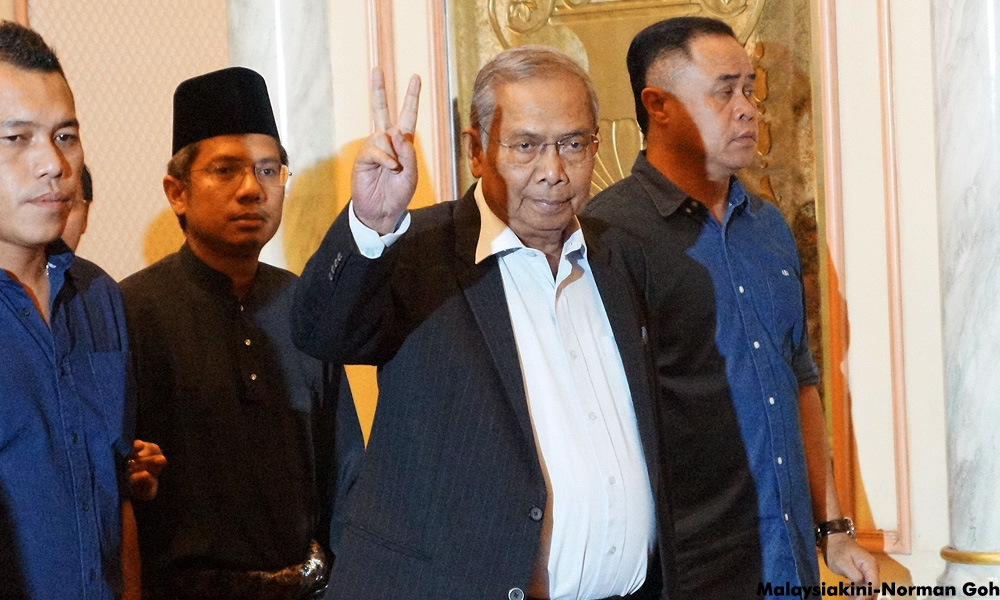
Tan Sri Adenan Satem. Image by Norman Goh from Malaysiakini.
Article 8 of MA63 says that Sabah and Sarawak can take their own measures to enforce and implement MA63, without having to amend the Federal Constitution.

Article 8, Malaysia Agreement 1963 (in part):

The Governments of the Federation of Malaya, North Borneo and Sarawak will take such legislative, executive or other action as may be required to implement the assurances, undertakings, recommendations….in so far as they are not implemented by express provision of the Constitution of Malaysia

In November 2016, then-Chief Minister Datuk Patinggi Tan Sri Adenan Satem initially proposed a motion to reclaim Sarawak's rights under MA63 in the state assembly, but this was withheld at the last moment.


If the motion went ahead, it could be seen to be as the Sarawak state government using its right under Article 8 of MA63. Instead the state government opted on a diplomatic approach with the federal government on resolving the issue of unfulfilled rights under MA63.


4. Sabah and Sarawak has extra autonomy to make decisions because of MA63

Sabah and Sarawak joined Malaya in forming Malaysia with the understanding that there will be guarantees within the Federal Constitution to protect their rights and privileges.

These guarantees and safeguards have since been inserted into the Constitution and relevant laws. Some of these privileges include:

Non-Sabah and Sarawak lawyers do not have the right to practise in Sabah and Sarawak courts (Article 161B).

As a result of Article 161B, lawyers from Peninsular Malaysia are not allowed to practise in Sabah and Sarawak without applying for a licence from the High Court of Sabah and Sarawak.  Even if they have the obtained the licence, they would still have to apply for a work permit from the state Immigration Department.

Sabah and Sarawak still have the right to use English in its state assembly and court proceedings (Article 161(1) and (2)).

Article 161(1) forbids any law that restricting Sabah and Sarawak's right to use English for official purposes until after ten years from 16th September 1963.

As of today the National Language Act 1963/1967 has not yet come into force in Sarawak. This means that it is still not mandatory for the state to use Bahasa Malaysia in government departments and state ministries.

Section 1(2), National Language Act:
This Act shall come into force in the States of Sabah and Sarawak on such dates as the respective State Authorities may by enactments of the Legislatures of the respective States appoint and different dates may be appointed for the coming into force of different provisions of this Act in those States.


5. Sarawak and Sabah has its own immigration law


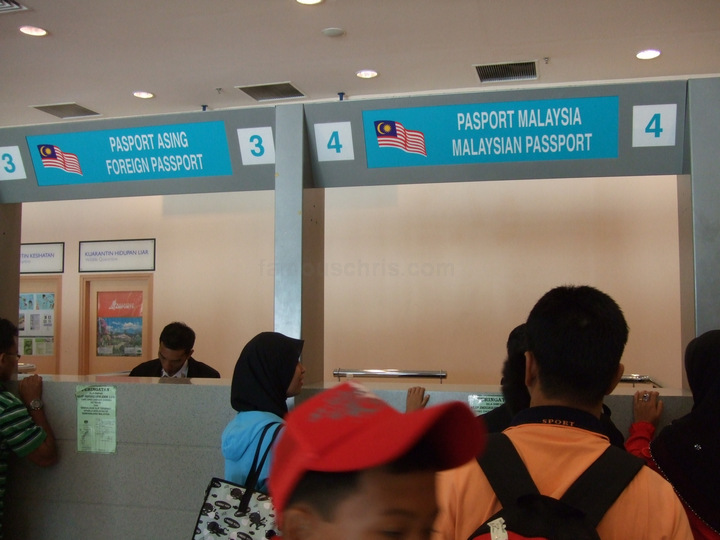
Immigration counter in Kota Kinabalu, Sabah. Image from FamousChris.
Sarawak and Sabah have the power to regulate immigration to their states.  In fact, Malaysians from the Peninsula require a permit if they want to work or study in Sarawak or Sabah. Those who are on a short visit to Sarawak and Sabah will have to fill an immigration form for a 90-day visit pass.

This restriction is laid in in Section 66 of the Immigration Act 1959/1963, and was included because of MA63.

Section 66(1), Immigration Act 1959/1963 (in part):
"... a citizen shall not be entitled to enter an East Malaysian State without having obtained a Permit or Pass in that behalf unless—
(a) he belongs to the East Malaysian State..."

These restrictions are apparently implemented to limit entry to those who can positively contribute to (either) state, while keeping their borders off-limits anyone who may pose a threat to order and security.
 
 
This article is for informational purposes only and should not be taken as legal advice.  Every situation is unique and dependent on the facts (ie, the circumstances surrounding your individual case) so we recommend that you consult a lawyer before considering any further action.  All articles have been scrutinized by a practicing lawyer to ensure accuracy.