Pages

Powered By Blogger

Monday, 1 March 2021

 CNA Insider

(https://www.channelnewsasia.com/news/cnainsider/fight-save-bangkok-sinking-watery-depths-floods-climate-change-12550382)

The fight to save Bangkok from sinking into watery depths

A green basin, an urban farm and a floating home — the programme Insight explores the solutions being devised to keep climate change and floodwaters at bay in the Thai capital.

Families in Bangkok are often faced with floods. But is it a problem with no end in sight?

Bookmark

BANGKOK: When landscape architect Kotchakorn Voraakhom and her landscape design studio, Landprocess, created a park in central Bangkok in 2017, it was no ordinary park.

It was a green basin to help the city soak up excess water — up to 4.5 million litres — by funnelling water into underground tanks, for example, and thus reduce monsoon flooding.

The 4.4-hectare Chulalongkorn University Centenary Park also consists of wetlands, a rain garden and an underground water drainage system.

“This public green space … is helping us to collect the water, helping us to create (cleaner) air, helping us in terms of a healthy space for the citizens,” said Kotchakorn.

“This is part of the solution that can be replicated … within the city. That (is), we need more space to hold the water.”

Such solutions are needed because Bangkok is buckling under the weight of urban development, with its buildings putting downward pressure on the land.

And nearly 40 per cent of this low-lying city may be flooded each year by 2030 owing to extreme rainfall and changes in weather patterns, according to the World Bank.

READ: Meet Thailand's secret weapon in climate change battle

But as the programme Insight discovers, there are ways to stop this tourist haven from sinking, and protect it against the rising tide. (Watch the episode here.)

AGENCIES FOUND WANTING

The Thai capital, with a population of about 10 million, sits in the Chao Phraya river delta and is caught between the rising sea level — four millimetres a year — and land subsidence of up to two centimetres a year.

READ: Why Manila is at risk of becoming an underwater city

READ: Why Jakarta is the fastest sinking city in the world


Bangkok’s chief resilience officer, Supachai Tantikom, explained that the soil underlying the city generally consists of alternating layers of soft clay and sand. “We don’t have any rock layers. And there are a lot of aquifers,” he said.

“In the past, we used a lot of underground water … so this has caused land subsidence.”

Bangkok’s chief resilience officer, Supachai Tantikom, says the city lies atop soft clay and sand.
Dr Supachai Tantikom.

Frequent flooding resulting in part from climate change has worsened the situation.

Just an hour south of Bangkok, the once-thriving fishing village of Samut Chin has already had to move inland several times over the years, owing to coastal erosion and rising sea levels.

Village head Wisanu Kengsamut said that despite repeated calls to the government to address the problem, nothing much had been done. “Regarding the coastal erosion problems, the government agencies provided very little help in the past,” complained the 37-year-old.

“Even now, we don’t receive any significant assistance from them on these issues. Our community faces the severest problem of coastal erosion in Thailand.”

Wisanu Kengsamut is the head of Samut Chin, a fishing village that is an hour south of Bangkok.
Wisanu Kengsamut.

Some residents in the country have felt that the government has not done enough to tackle the problems of flooding since 2011, when Thailand’s worst floods in half a century resulted in more than 800 deaths nationwide.

In the capital, floodwaters inundated parts of the city for almost three months. The severity of the situation caught many residents — and the authorities — off guard.

Somsak Meeudomsak, deputy director-general of Bangkok’s Department of Drainage and Sewerage, said the drainage systems in the provinces were not adequate. “In Bangkok … our water management system was also not good enough compared to now,” he added.

THE MONKEY CHEEK CONCEPT

The problems facing Bangkok have set some people, including Kotchakorn, thinking how best to resolve them.

Frequent flood problems in Bangkok, a result of urban growth and climate change.

The city used to be known as the Venice of the East because of its canals, but many of these have been paved over because of urban growth. The rainwater they channelled has nowhere to go now.

“We (weren’t) concerned about our natural waterways … (and) how the water would drain,” said Kotchakorn, who is also the chief executive officer of social enterprise Porous City Network.

“We have so many dams upstream, and that’s preventing us (Bangkok) from having sediments … With less sediments (in the delta), the land can’t grow.”

The 39-year-old also believes that rapid urbanisation has swallowed up the city’s greenery, leading to a temperature rise.

It hasn't been easy for Kotchakorn Voraakhom to convince others to see the big environmental picture
It hasn't been easy for her to convince clients, authorities and other businesses to see the big environmental picture in a megacity obsessed with economic targets and expansion. (Photo: AFP/Lillian Suwanrumpha)

“Rapid growth without … really planning to have enough green spaces or natural elements in the city (has) cost so much in terms of the pollution and the well-being of people,” she said.

She is pushing for more sustainable development solutions to combat climate change, including re-introducing nature into the city.

For example, the Centenary Park serves as a kaem ling (monkey cheek) water-retention area for the community, like how a monkey holds food in its cheeks until it needs to eat.

Under normal conditions, water that is not absorbed by plants flows into the park’s storage system, where it is stored for watering during dry periods.   When floods hit, the containers hold water and release it after the flooding has subsided.

WATCH: Asia's Sinking Cities: Bangkok (45:58)

Combating floods through design is just one of the many functions of Kotchakorn’s designs.

ASIA’S BIGGEST ROOFTOP FARM

With buildings crowding the streets, she has also turned to underutilised spaces to introduce nature by, for example, creating Asia’s biggest rooftop farm at Thammasat University.

The 7,000 square metre space mimics rice terraces and can help to curb some of the impact of climate change, she said.

Prinya Thaewanarumitkul, the university’s vice-rector for sustainability and administration, noted that buildings with a green roof will consume less air conditioning.

Architect Kotchakorn Voraakhom created Asia’s biggest rooftop farm at Thammasat University.
The rooftop farm at Thammasat University.

“We need (this) green roof to reduce the use of energy (and) reduce the release of carbon dioxide into the atmosphere,” he said.

Another architecture firm, Site-Specific, had earlier designed and built an amphibious house for Thailand’s National Housing Authority to help fight flooding.

The trial house in nearby Ayutthaya, a province grappling with floods, has steel pontoons filled with styrofoam, which can lift the house off the ground if floods occur.

The government has taken other steps to ensure that homes are flood-proof and that the calamity of 2011 does not recur.

Work is needed to flood-proof homes in Bangkok.

These flood prevention initiatives include the dredging of canals, improving Bangkok’s drainage systems and increasing the height of a 77-km flood wall along the Chao Phraya River.

The Bangkok Metropolitan Administration (BMA) has also been building underground “water banks”, or large artesian wells, to retain rainwater during heavy downpours.  Inspired by a similar project in Japan, these wells will be connected with pipes and gutters to receive floodwater.

The BMA also launched a programme to replant mangrove forests, with the target of restoring almost 65 hectares of coastline.

Kotchakorn, however, feels that the city has a long way to go in resolving its flood problems and rising water levels — and that research has not necessarily translated into action.

The city has only just begun to find the solutions, says Kotchakorn.

“We have to be more action-oriented, rather than just keeping all this research on climate change on the shelf.  So the policymakers or the community have to come together,” she said.

“There’s so much work to be done ... And we need to act faster.”


Bangkok examines flood prevention plansDec 2011

Shani Wallis, TunnelTalk
Devastating floods across wide areas of the Bangkok metropolitan area have prompted engineers and officials in Thailand to address urgently needed programmes and projects that would mitigate the annual threat and ensure that the city is prepared to prevent any repeat of this typhoon season's economically and socially crippling disaster. TunnelTalk Editor, Shani Wallis, attended a press conference last week in Bangkok at which the tunneling society of Thailand presented its undergroud proposal for long term flood mitigation and control.

Bangkok inundated

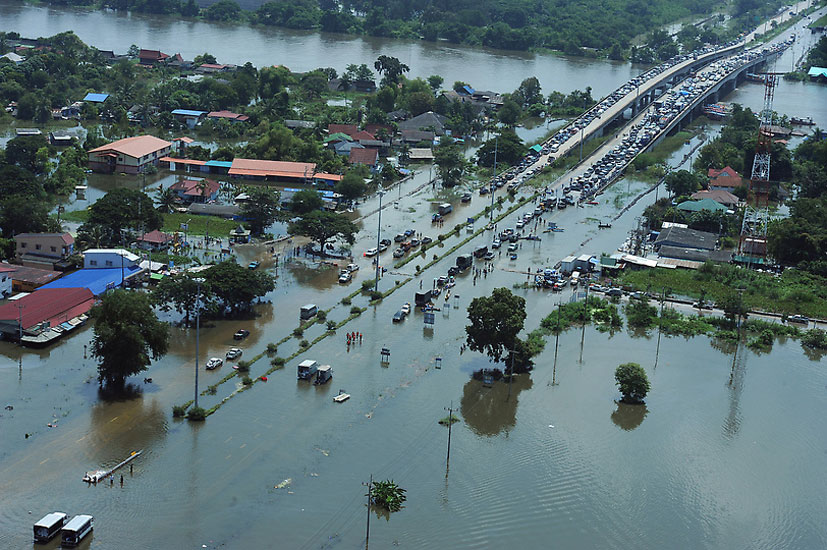
        Flood water metres deep in the streets and homes of Bangkok during September, October and November took a heavy toll on the citizens and the fabric of the city. Incredibly, more than two months after the first inflows, flood water still lies across low-lying areas of the city's suburbs with fears of waterborne diseases and families struggling to salvage what they can of their possessions still the focus of local news reports.

        Struggling now with the aftermath of the worst floods in the city's recent history, engineers in Thailand have mobilised to present new infrastructure projects that will prepare the city for predictable flood events in the future.

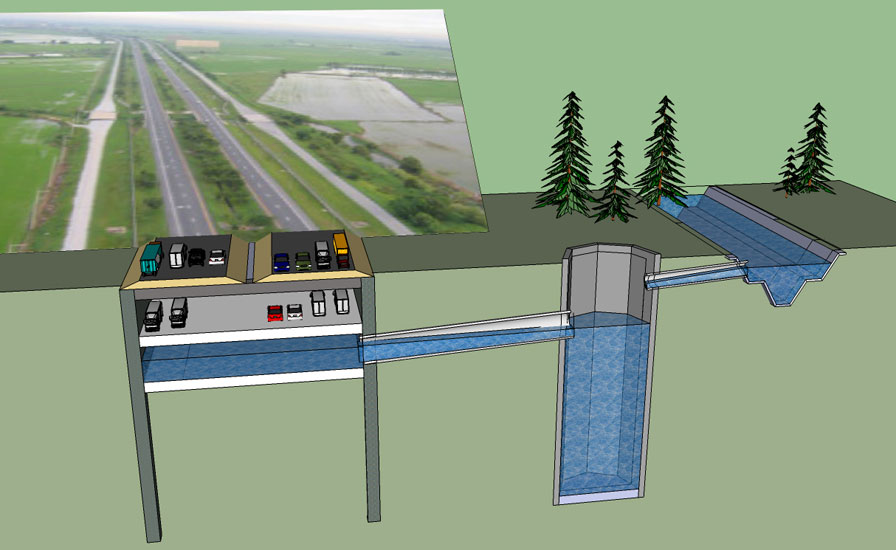
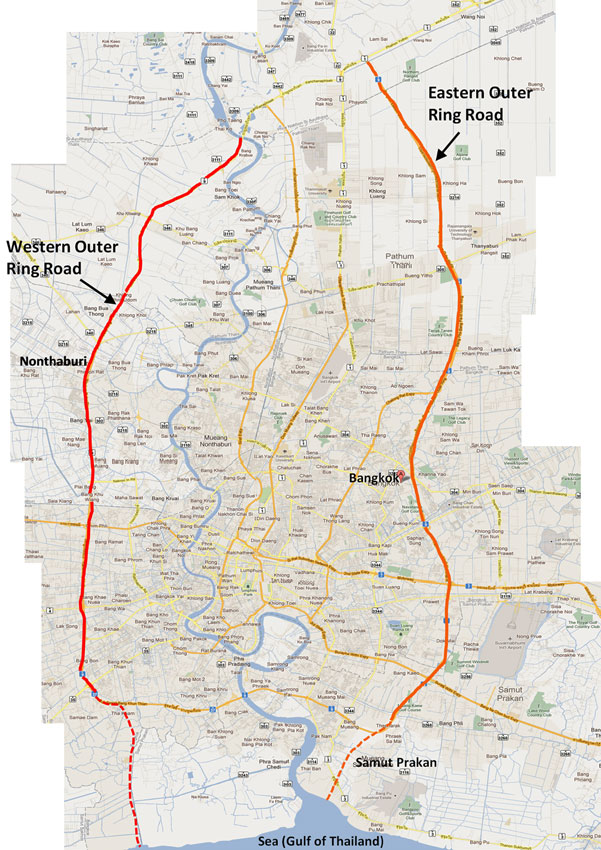
         Like so many cities that have implemented comprehensive flood control systems, one of the leading plans that is gaining political support for Bangkok is based on extensive underground excavation with multi-purpose functionality possibilities.   A plan to excavate a double deck cut-and-cover facility beneath the existing six to eight-lane Eastern Outer Ring Road that stretches 100km from the northern suburbs and runs parallel with the river would deliver floodwater to the Gulf of Thailand.

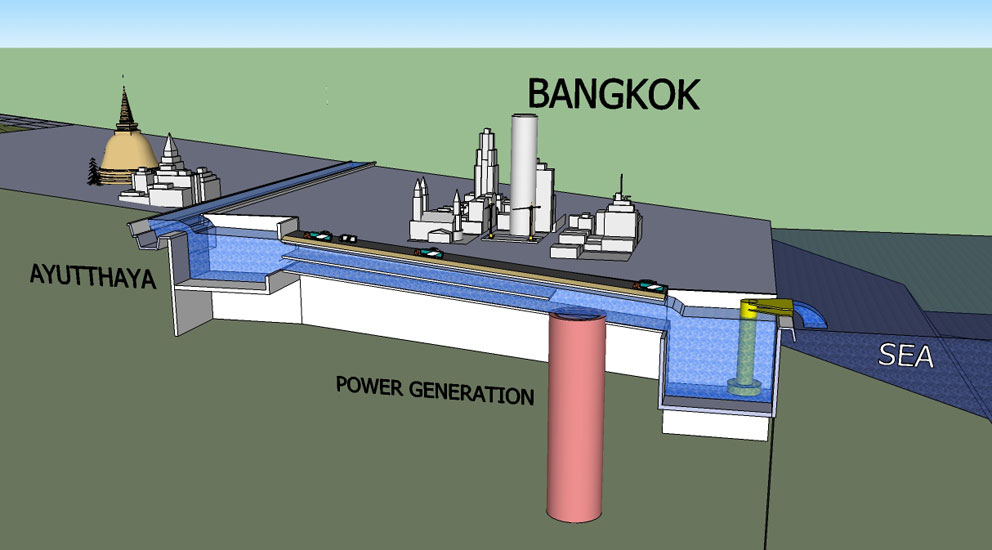
         At times of heavy flooding the entire 24m wide x 10m high cut-and-cover facility would provide a channel for floodwater. During normal times, the lower deck would remain reserved as a drainage channel while the upper deck would accommodate another six lanes of highway traffic to the already heavily congested highway above.

       The waters that flooded into vast areas of the northern suburbs of Bangkok were created by a perfect storm of circumstances, according to members of TUTG, the Thailand Underground and Tunnelling Group that will host the World Tunnel Congress (WTC) and 38th General Assembly of the International Tunnelling and Underground Space Association (ITA) in May next year (2012).

Underground option gaining traction as the possible solution for Bangkok

Underground option gaining traction as the possible solution for Bangkok

        "First, the heavy rains of two typhoons at the start of the season in August hit the upper reaches and catchment of the Chao Phraya River," explained Zaw Zaw Aye, Tunnelling Director of the Thai construction company Seafco and Secretary General of the WTC organising committee. "After months of no rain, these were held in the reservoirs which filled very quickly. At that point, another three typhoons hit the area in quick succession and vast amounts of water had to be released from the dams.  The water had to come down the Chao Phraya River to the Gulf of Thailand.   The problem in the city is that rapid urbanisation during recent years has seen new housing estates developed on land that once accommodated traditional rice paddy fields on which the annual flood waters were welcomed.  In addition, urban flood defences have not kept pace with developments that have blocked many of Bangkok's klongs, or canals, creating development barriers to Chao Phraya River flood waters."

When water released from the dams came down the river it was evident that parts of the city would flood.  As well as the klongs, Bangkok has flood control defences, including a set of new drainage tunnels.  The first, in the city centre (5km long x 5m diameter and with a 60m3/sec capacity) is complete; another is under construction (6km x 5m diameter); and two more are in the planning stages (the 13.5km x 5m diameter Don Muang tunnel and the 9.5km x 5m diameter Suan Luang Ro 9 tunnel which will drain an area of 85km2).  But these were not able to help Bangkok to full measure on this occasion.

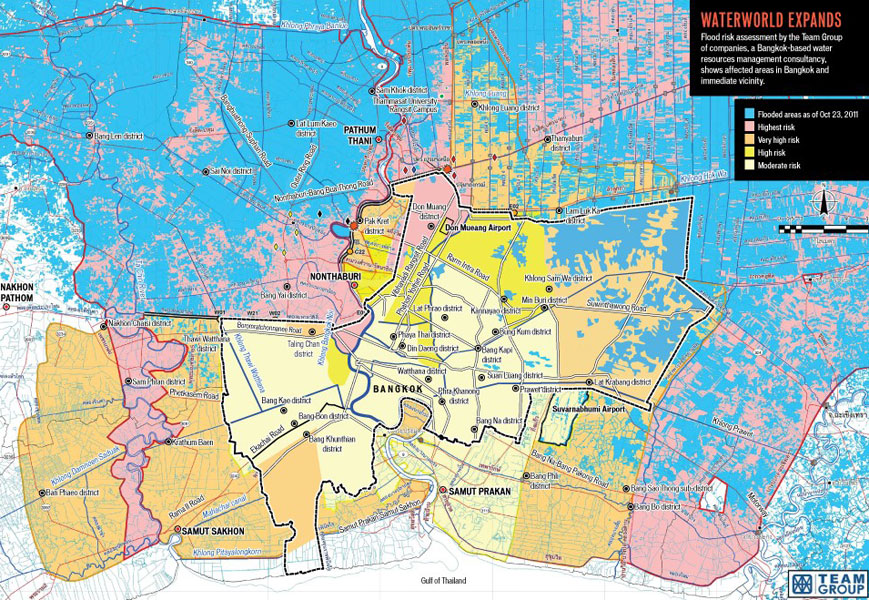
Extent of the floods around Bangkok's protected city centre

        "The current systems can manage between 6-10 million m3/day," explained Zaw, "but more than 11 billion m3/day of water was coming down the river. The city could only drain a third of it."

        City authorities used all existing systems, including floodgates and the diversion weirs on the klongs, to protect the city centre, with the surge spreading out in three directions to inundate the northern, eastern, and western areas.  Even Bangkok's new international airport, opened two years ago on the east side of the city, was not spared. Many had warned against building the airport on the eastern flood plain.

        Through all, Bangkok's metro system, with some 21km of the 50-60km network underground and the rest elevated, never shut down. "Some underground station entrances were closed," explained Zaw, who worked on the construction of underground sections of the system, "but the network is designed for a 100-year flood and all, or most, underground stations have elevated entrances as well as flood doors. I personally went to see how the flood doors performed in the emergency as I was involved in the design and installation of several."

        As it happened, the metro was the only reliable method of transport through the wider city, including into the flooded areas on the elevated sections. "Buses could not operate and most private cars were out of action or parked on the elevated highways out of harm’s way, which completely chocked off the highways."

        For other underground utility services, the potable water system was affected initially but was returned quickly to full service as much of the floodwater was not contaminated. The sewerage systems backed up and overflowed, a situation that brought with it the threat of waterborne disease and the liberal use of chlorine as a quick-fix response. As well as damage to homes, shops and businesses, a visit to Bangkok last week by TunnelTalk revealed that even now there are stacks of sandbags on standby in the city centre. Small walls with stiles over them have been built in front of some smaller shops as a more permanent protection measure.

         There is also still an acute shortage of food, bottled water and drinks in the shops. There was no flood water to be seen but reports were of many low-lying areas, some including luxury residential estates, still remaining under water.

        The aftermath of the disaster has included heavy criticism of Thailand's new Government and its failure to address the looming crisis, as well as inadequate management of the upstream reservoirs where officials were caught out completely by the deluge.

        The reaction by the Government and City authorities has been to begin afresh the development of plans to prepare the city for what engineers know will happen again.  The rapid urbanisation of the city and building on the natural floodways make a repeat of the disaster a certainty without urgent action.  The new network of 5m diameter drainage tunnels is designed more for stormwater management, not for a massive surge of water down the river from upstream. Something much more substantial and of much greater capacity is needed, and tunnelling engineers in Bangkok have illustrated how underground flood mitigation methods are the only feasible option.

·         Chicago TARP

Chicago TARP

·         Chicago TARP

·         Tokyo G-CANS

Tokyo G-CANS

·         Tokyo G-CANS

·         Hong Kong Drainage

Hong Kong Drainage

·         Hong Kong Drainage

·         Kuala Lumpur SMART

Kuala Lumpur SMART

·         Kuala Lumpur SMART

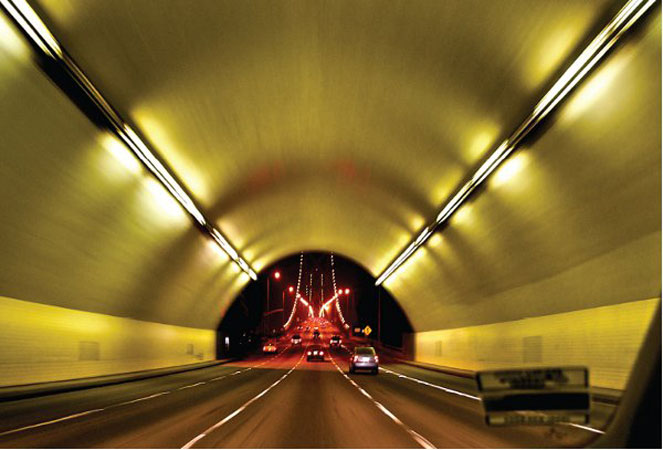
        At a press conference last week TunnelTalk joined the audience to hear of how systems such as Chicago's TARP, Tokyo's tremendous G-CANS underground flood channels and retention caverns, Hong Kong's major new flood control tunnelling networks and Kuala Lumpur's innovative dual purpose Stormwater Management And Road Tunnel (SMART) project, have inspired Thai engineers to develop their own Multi-Service Underground Tunnel System, or MUSTS.

Proposed multi-purpose flood relief project runs beneath the Outer Ring Road, first on the east side and eventually also on the west side

Proposed multi-purpose flood relief project runs beneath the Outer Ring Road, first on the east side and eventually also on the west side

      "The underground addresses several major issues," said Engineer Professor Dr Suchatchawi Vince Suwannasawat, Dean of Civil Engineering at King Mongkut's Institute of Technology Ladkrabang who is also President of Thailand's TUTG tunnelling society and Congress Chairman of WTC 2012.

        "First it avoids expensive procurement of private property for new

surface flood canal options; secondly it limits the impact of what will be a massive construction operation to the corridor of an existing public highway."

        The underground solution also better allows for gravity-feed of the flood facility towards the sea, a major concern for surface options that often require large pumping systems or deep cuts. In operation, the lower deck of the underground facility would have a capacity of 130 million m3/day. This would increase to 260 million m3/day with both decks of the facility turned to flood control mode.

        In addition, the multi-service system includes the possibility of generating power. Directing water down deep shafts would create the necessary hydrostatic head needed to operate a turbine installed in the bottom. Depending on the selected size of the project, between 200-600MW of electricity could be produced by extending the project's multi-service system application.

        At the press conference in Bangkok on Wednesday last week, Dr Suwannasawat explained that Phase 1 of the project, for the 100km facility under the East Ring Road, would demand a Government investment of some 200 billion Thai Baht (US$6.3 billion). He went on to explain that, set against the estimated 1.4 trillion Baht cost of the current disaster, the project represents a proposal that should be advanced as soon as possible. The multi-service functionality of the project also presents the possibility of imposing tolls on the roadway to raise funding towards its construction and maintenance. There is also potential for generating electricity to support its own operating costs.   

        The project has won early political backing with Deputy Governor Teerachon Manomaiphilbul of the Bangkok Metropolitan Administration speaking in support of the proposal and urging the central Government to implement the project stating: "It is a huge investment and one that I agree with."

Global theme for international congress
        In welcoming the 64-member nations of the ITA to Bangkok in May next year and the anticipated 1,500-2,000 delegates, the TUTG Organising Committee has selected 'Tunnelling and Underground Space for a Global Society' as its congress theme. The fact that the host city has suffered the kind of natural disaster that looms large for many of the world's other major mega-cities will certainly draw extra interest.   

       Delegates will be interested to hear first hand reports of how the disaster happened, how the city coped and more importantly how the Government, authorities and engineers plan to prepare the Bangkok to avoid similar disasters in future.

MUSTS includes the potential for generating electricity

MUSTS includes the potential for generating electricity

The experience will profile significantly also in the Congress Open Session, organised by ITACUS, the ITA Committee on Underground Space that is examining the development of resilient cities over the course of the next three years.

Launched this year at the WTC2010 in Helsinki in May, the theme of Delivering Better and Resilient Cities discussed in Finland, continues in Bangkok in May 2012 where the forum will centre on Planning Better and Resilient Cities, before moving to Geneva in 2013 where delegates will close the series with a discussion on Deciding Better and Resilient Cities.  A special one-day registration is offered for delegates who would like to join the Open Session as a stand alone event rather than the full tunnelling congress programme.  There is much to consider and develop on this wide ranging and vital topic and Bangkok's recent flood experience makes it a most appropriate venue for hosting the discussion in May 2012.  A welcome and invitation to attend is extended to all from the TUTG Organising Committee.

References

Helsinki WTC2011 Congress video report - TunnelCast, May 2011
Brisbane averts underground works inundation TunnelTalk, Jan 2011
Concerns and consequences of seismic devastation - TunnelTalk, March 2011
Santiago Metro survives massive earthquake - TunnelTalk, March 2010

WTC2012 Bangkok Thailand
ITACUS
ITA

Friday, 26 February 2021


我有话说  27/2/21

对张泰卿商人兼砂议员捐献两超音波扫描仪器给诗巫医院,我们人民不用一点丁儿感恩他。星洲日报(24/2/2021)标题是【2超音波扫描仪捐巫医院  张泰卿为抗疫助力】。我倒认为他一贯以来在砂议会里完全没有全心全意的为诗巫好好的,正当的诉求砂医院的真正需求。如果,他和其他诗巫DUN议员像Annuar Rapaee真的,真的,真的,有真心诚意的争取购买诗巫医院所需要的仪器,诗巫医院不会沦陷到今天这样的地步。医院的仪器破旧不堪或不够到这模样。 临时,紧急面对无法应付的地步。

                过去华小拨款不足,他也是玩这种小恩小徳的玩意儿,把自己的薪水捐献博取人民的赞赏。我一直是把他看成无能为华小争取拨款,所以找这种后路。  BN-GPS议员一年有多少拨款,他真的要好好的拿出来有利于人民花用。在DUN里坚持政府, 不管是所谓的联邦或砂议会争取到底,这不是人民选部长的用意吗? 近几年,华小总于有拨款了。 现在,是诗巫医院欠缺仪器和应有的设备。

                齐全所有医疗仪器设备给砂医院,不是砂政府和所谓联邦政府的职责吗? 如果大公司大老板有意做捐献 ,他们应该去做那些非政府职责的事。不要抢着去做政府理应做的事,因为你们使政府推卸责任。毕竟大公司大老板的资源有限,远远也比不上政府的资源。你们这么做就搞砸了政府应尽的责任。 这么多年下来,都是这么样和这模样,所以政府就能省则省,拨款的事儿,就这样那样省了起来进了谁谁谁的口袋。点到为此。  林梅芳

Thursday, 18 February 2021


针对募款的事儿,我有话说--   19/2/21

池德峰 发动募款建化验室  张庆信 助抗疫何错之有?(星洲日报 18/2/2021

        税收后或钱拿了不做事,还敢耍赖。再向人民开刀,还要向人民募款去建化验室,这是那一门的逻辑? 一直以来,无知的阿狗阿猫任由部长先生,女士和小姐们摆布,官家们耍惯这些招术了。从过去到现在,我们这些无能的部长先生,女士和小姐们总是向民众要求捐款各种款项从学校建设到医院种种样样总是有机会便向人民开刀要捐款。税收后,这些钱到底去了那里? 我希望人民要懂得追问,不是强着去帮忙盗贼去凑更多钱给他们去花。不要再制造【民贫官家富】的状况了。

     是时候切除部长们尤其是华人部长这种恶习。我从90年代看到现在,级度让人恶心。 我希望人民够醒目,拒绝税后,还要负责那些政府不负责的事项,别犯贱,别抢着去做政府应该做的事。今天还有部长毫无羞耻心的向民众募款是因为咱们人民的极度无知所造成的后果。 是时候切除拨正这种恶习。最可怕是还有民众支持部长这么做。 很贱也!   林梅芳