tunneltalk.com
Bangkok examines flood prevention plans Dec 2011
Shani Wallis, TunnelTalk
Devastating floods
across wide areas of the Bangkok metropolitan area have prompted engineers and
officials in Thailand to address urgently needed programmes and projects that
would mitigate the annual threat and ensure that the city is prepared to
prevent any repeat of this typhoon season's economically and socially crippling
disaster. TunnelTalk
Editor, Shani Wallis, attended a press conference last week in
Bangkok at which the tunneling society of Thailand presented its undergroud
proposal for long term flood mitigation and control.

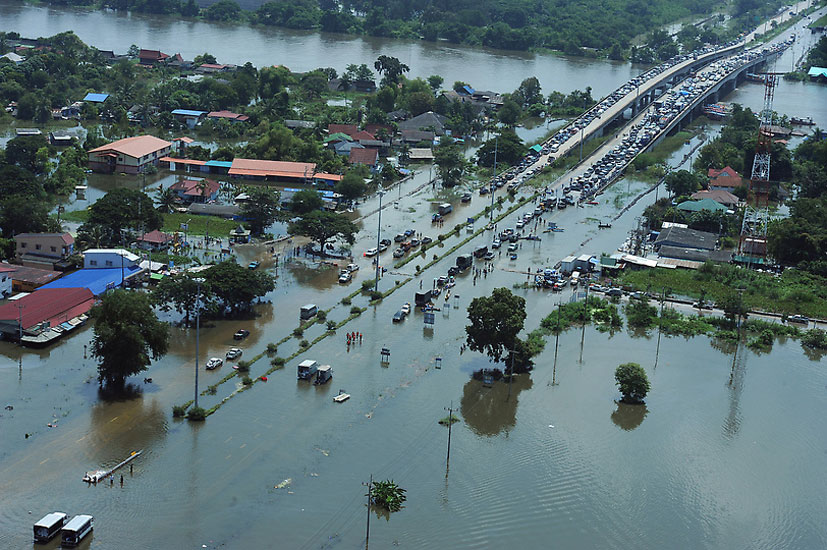
Bangkok inundated
Flood water metres
deep in the streets and homes of Bangkok during September, October and November
took a heavy toll on the citizens and the fabric of the city. Incredibly, more
than two months after the first inflows, flood water still lies across
low-lying areas of the city's suburbs with fears of waterborne diseases and
families struggling to salvage what they can of their possessions still the focus
of local news reports.
Struggling now with
the aftermath of the worst floods in the city's recent history, engineers in
Thailand have mobilised to present new infrastructure projects that will
prepare the city for predictable flood events in the future.
Like so many cities
that have implemented comprehensive flood control systems, one of the leading
plans that is gaining political support for Bangkok is based on extensive
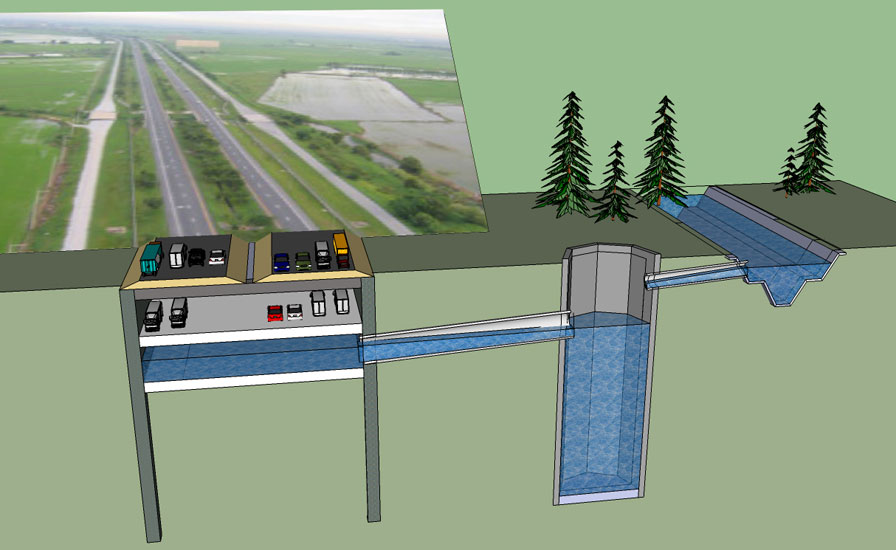
underground excavation with multi-purpose functionality possibilities. A plan
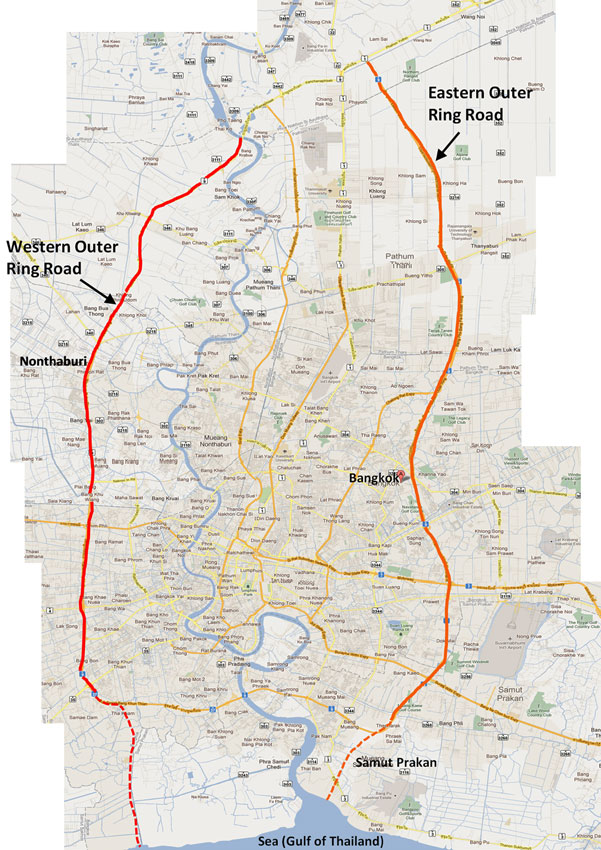
to excavate a double deck cut-and-cover facility beneath the existing six to
eight-lane Eastern Outer Ring Road that stretches 100km from the northern
suburbs and runs parallel with the river would deliver floodwater to the Gulf
of Thailand.
At times of heavy
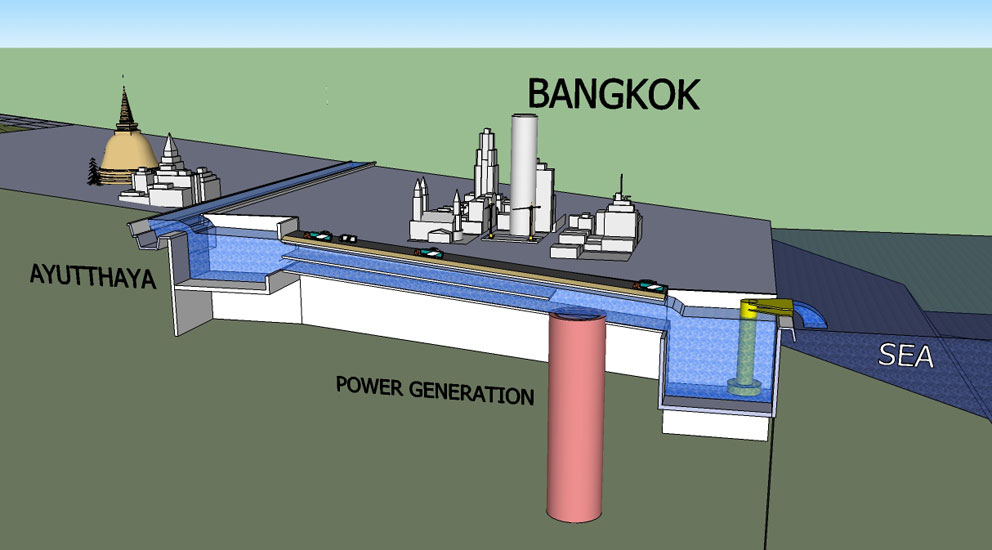
flooding the entire 24m wide x 10m high cut-and-cover facility would provide a
channel for floodwater. During normal times, the lower deck would remain
reserved as a drainage channel while the upper deck would accommodate another
six lanes of highway traffic to the already heavily congested highway above.
The waters that
flooded into vast areas of the northern suburbs of Bangkok were created by a
perfect storm of circumstances, according to members of TUTG, the Thailand
Underground and Tunnelling Group that will host the World Tunnel Congress (WTC)
and 38th General Assembly of the International Tunnelling and
Underground Space Association (ITA) in May next year (2012).

Underground option gaining traction as the possible
solution for Bangkok
"First, the
heavy rains of two typhoons at the start of the season in August hit the upper
reaches and catchment of the Chao Phraya River," explained Zaw Zaw Aye,
Tunnelling Director of the Thai construction company Seafco and Secretary
General of the WTC organising committee. "After months of no rain, these
were held in the reservoirs which filled very quickly.
At that point,
another three typhoons hit the area in quick succession and vast amounts of
water had to be released from the dams. The water had to come down the Chao
Phraya River to the Gulf of Thailand. The problem in the city is that rapid
urbanisation during recent years has seen new housing estates develope on land
that once accommodated traditional rice paddy fields on which the annual flood
waters were welcomed.
In addition, urban
flood defences have not kept pace with developments that have blocked many of
Bangkok's klongs, or canals, creating development barriers to Chao Phraya River
flood waters."
When water released
from the dams came down the river it was evident that parts of the city would
flood. As well as the klongs, Bangkok has flood control defences, including a
set of new drainage tunnels. The first, in the city centre (5km long x 5m
diameter and with a 60m3/sec capacity) is complete; another is under
construction (6km x 5m diameter); and two more are in the planning stages (the
13.5km x 5m diameter Don Muang tunnel and the 9.5km x 5m diameter Suan Luang Ro
9 tunnel which will drain an area of 85km2). But these were not able
to help Bangkok to full measure on this occasion.

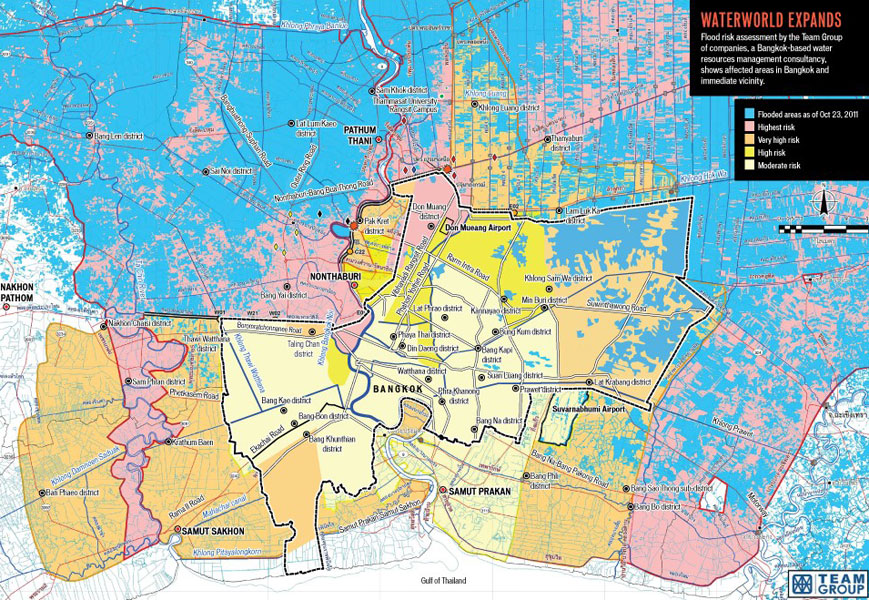
Extent of the floods around Bangkok's protected city
centre
"The current
systems can manage between 6-10 million m3/day," explained Zaw,
"but more than 11 billion m3/day of water was coming down the
river. The city could only drain a third of it."
City authorities
used all existing systems, including floodgates and the diversion weirs on the
klongs, to protect the city centre, with the surge spreading out in three
directions to inundate the northern, eastern, and western areas. Even Bangkok's
new international airport, opened two years ago on the east side of the city,
was not spared. Many had warned against building the airport on the eastern
flood plain.
Through all,
Bangkok's metro system, with some 21km of the 50-60km network underground and
the rest elevated, never shut down. "Some underground station entrances
were closed," explained Zaw, who worked on the construction of underground
sections of the system, "but the network is designed for a 100-year flood
and all, or most, underground stations have elevated entrances as well as flood
doors. I personally went to see how the flood doors performed in the emergency
as I was involved in the design and installation of several."
As it happened, the
metro was the only reliable method of transport through the wider city,
including into the flooded areas on the elevated sections. "Buses could
not operate and most private cars were out of action or parked on the elevated
highways out of harm’s way, which completely chocked off the highways."
For other
underground utility services, the potable water system was affected initially
but was returned quickly to full service as much of the floodwater was not
contaminated. The sewerage systems backed up and overflowed, a situation that
brought with it the threat of waterborne disease and the liberal use of
chlorine as a quick-fix response.
As well as damage to
homes, shops and businesses, a visit to Bangkok last week by TunnelTalk revealed that
even now there are stacks of sandbags on standby in the city centre. Small
walls with stiles over them have been built in front of some smaller shops as a
more permanent protection measure. There is also still an acute shortage of
food, bottled water and drinks in the shops. There was no flood water to be
seen but reports were of many low-lying areas, some including luxury
residential estates, still remaining under water.
The aftermath of the
disaster has included heavy criticism of Thailand's new Government and its failure
to address the looming crisis, as well as inadequate management of the upstream
reservoirs where officials were caught out completely by the deluge.
The reaction by the
Government and City authorities has been to begin afresh the development of plans
to prepare the city for what engineers know will happen again. The rapid
urbanisation of the city and building on the natural floodways make a repeat of
the disaster a certainty without urgent action. The new network of 5m diameter
drainage tunnels is designed more for stormwater management, not for a massive
surge of water down the river from upstream. Something much more substantial
and of much greater capacity is needed, and tunnelling engineers in Bangkok
have illustrated how underground flood mitigation methods are the only feasible
option.
|

Chicago TARP

|

Tokyo G-CANS

|

Hong Kong Drainage

|

Kuala Lumpur SMART

|
At a press
conference last week TunnelTalk
joined the audience to hear of how systems such as Chicago's TARP, Tokyo's
tremendous G-CANS underground flood channels and retention caverns, Hong Kong's
major new flood control tunnelling networks and Kuala Lumpur's innovative dual
purpose Stormwater Management And Road Tunnel (SMART) project, have inspired
Thai engineers to develop their own Multi-Service Underground Tunnel System, or
MUSTS.

Proposed
multi-purpose flood relief project runs beneath the Outer Ring Road, first on
the east side and eventually also on the west side
"The underground addresses several major
issues," said Engineer Professor Dr Suchatchawi Vince Suwannasawat, Dean
of Civil Engineering at King Mongkut's Institute of Technology Ladkrabang who
is also President of Thailand's TUTG tunnelling society and Congress Chairman
of WTC 2012.
"First it
avoids expensive procurement of private property for new surface flood canal
options; secondly it limits the impact of what will be a massive construction
operation to the corridor of an existing public highway."
The underground solution also better allows for
gravity-feed of the flood facility towards the sea, a major concern for surface
options that often require large pumping systems or deep cuts. In operation,
the lower deck of the underground facility would have a capacity of 130 million
m3/day. This would increase to 260 million m3/day with
both decks of the facility turned to flood control mode.
In addition, the
multi-service system includes the possibility of generating power. Directing
water down deep shafts would create the necessary hydrostatic head needed to
operate a turbine installed in the bottom. Depending on the selected size of
the project, between 200-600MW of electricity could be produced by extending
the project's multi-service system application.
At the press
conference in Bangkok on Wednesday last week, Dr Suwannasawat explained that
Phase 1 of the project, for the 100km facility under the East Ring Road, would
demand a Government investment of some 200 billion Thai Baht (US$6.3 billion).
He went on to explain that, set against the estimated 1.4 trillion Baht cost of
the current disaster, the project represents a proposal that should be advanced
as soon as possible.
The multi-service
functionality of the project also presents the possibility of imposing tolls on
the roadway to raise funding towards its construction and maintenance. There is
also potential for generating electricity to support its own operating costs.
The project has won
early political backing with Deputy Governor Teerachon Manomaiphilbul of the
Bangkok Metropolitan Administration speaking in support of the proposal and
urging the central Government to implement the project stating: "It is a
huge investment and one that I agree with."
Global theme for international congress
In welcoming the 64-member nations of the ITA to Bangkok in May next year and the
anticipated 1,500-2,000 delegates, the TUTG Organising Committee has selected
'Tunnelling and Underground Space for a Global Society' as its congress theme.
The fact that the host city has suffered the kind of natural disaster that
looms large for many of the world's other major mega-cities will certainly draw
extra interest. Delegates will be interested to hear first hand reports of how
the disaster happened, how the city coped and more importantly how the
Government, authorities and engineers plan to prepare the Bangkok to avoid
similar disasters in future.

MUSTS includes the potential for generating electricity
The experience will
profile significantly also in the Congress Open Session, organised by ITACUS,
the ITA Committee on Underground Space that is examining the development of
resilient cities over the course of the next three years.
Launched this year
at the WTC2010 in Helsinki in May, the theme of Delivering Better and Resilient
Cities discussed in Finland, continues in Bangkok in May 2012 where the forum
will centre on Planning Better and Resilient Cities, before moving to Geneva in
2013 where delegates will close the series with a discussion on Deciding Better
and Resilient Cities. A special one-day registration is offered for delegates
who would like to join the Open Session as a stand alone event rather than the
full tunnelling congress programme. There is much to consider and develop on
this wide ranging and vital topic and Bangkok's recent flood experience makes
it a most appropriate venue for hosting the discussion in May 2012. A welcome
and invitation to attend is extended to all from the TUTG Organising Committee.
References
Helsinki WTC2011 Congress video report - TunnelCast, May 2011
Brisbane averts underground works inundation - TunnelTalk, Jan 2011
Concerns and consequences of seismic devastation - TunnelTalk, March 2011
Santiago Metro survives massive earthquake - TunnelTalk, March 2010
WTC2012
Bangkok Thailand
ITACUS
ITA


 L
L