Pages

Powered By Blogger

Sunday, 8 November 2020

Fall of the house of Shah: end of an era for the world's last Hindu monarchy


theguardian.com

Fall of the house of Shah: end of an era for the world's last Hindu monarchy

Randeep Ramesh

Smearing red sandalwood paste on a line of worshippers gathered outside the main pagoda of the Nepali capital's imposing Pashupatinath temple complex, Hindu priest Raju Baje explains that the 400-odd shrines contain all but one of the religion's 330,000 deities.

Through the smoke of funeral pyres are stone statues of roaring lions, a giant bronze cow, endless wooden images of the divine and framed pictures of the 11 monarchs from the Shah dynasty that ruled Nepal in the last 240 years - except the current king, Gyanendra.

The present ruler, says Baje, is a god who has been thrown out of his own temple. "We consider the king a divine figure. He is the incarnation of Lord Vishnu. But if we put a picture of him up it will be ripped down. The people don't love him."

Today, Nepal's new constitutional assembly will hold its first meeting and end the monarchy, a key part of a 2006 peace deal with Maoist guerrillas who gave up the bullet for the ballot box on the condition that the country becomes a secular republic. The civil war lasted a decade and cost more than 13,000 lives.

The Maoists, who won last month's elections to become the largest party in Nepal's assembly, say that the monarch will have an "honourable exit", but the fall of King Gyanendra and the disappearance of the world's last Hindu monarchy has been dramatic.

In the past few months the word "Royal" has been dropped from the army and national airline. Gone from the national anthem are any references to the king. The royal family, consisting of the king, the queen, the queen mother, the crown prince and his wife and children, left their pink-hued palace in the centre of the capital last week for the last time.

There is little doubt that royal belts will have to be tightened. The monarch's state salary of $3m (£1.5m) has been revoked and the royal family's seven palaces are to be turned into museums. Even the queen was forced to give up her retinue of beauticians.

After today's vote the king, who once ruled by divine right, will be reduced to a commoner - albeit an extremely wealthy one with tea estates and tobacco holdings in the 12th poorest country in the world.

The transformation from kingdom to republic still leaves unanswered the questions of what an ex-royal will be allowed to do.

The king still enjoys support from Hindu extremists and elements in the armed forces, a small fringe perhaps, but enough for the politicians not to go too far in humiliating the palace.

A previously unknown Hindu nationalist group, angry with the removal of royalty, said it was responsible for a series of pipe-bomb explosions that rocked the capital on Monday.

Bhekh Thapa, a former foreign minister under the king, says the royal family will have to be "guarded" and probably have a "privy purse".

"This is a poor country with an large, uneducated population for whom the institution of monarchy is a symbol of unity. You have to tread carefully in dismantling it," he said. The Nepalese Maoists, said Mr Thapa, cannot replicate what their ideological mentor Chairman Mao did to China's last emperor, Puyi, whom he met in the mid 60s as a young diplomat.

"I was introduced to this tall man in a plain cotton suit sweeping the leaves in a palace in Beijing. The last emperor had been a keen gardener and so Chairman Mao let him stay on to prune trees and plant flowers. That could not happen in Nepal which is why our Maoists have been calling for a dignified exit."

Unfolding tragedy

The fall of the house of Shah is a story of bloodshed, betrayal and intrigue. For almost two-and-a-half centuries the monarchy persisted, buttressed by the central role the king played in the national religion, Hinduism.

Even when the palace ceded power to a parliament in 1990, the king remained in charge, retaining the right to dissolve parliament and control the army.

The sudden collapse of the monarchy in the span of a few years, say even former royalists, is not a victory for communism but a failure of the 60-year-old King Gyanendra. He was unable to win over his subjects, suspicious of a monarch enthroned after the worst royal slaughter since the Romanovs were murdered during the Russian civil war.

The beginning of the end for the Shah kings came in the summer of 2001 when then king Birendra and his family were assassinated in the palace by the drunk crown prince who later turned the gun on himself. Ten members of the royal family died.

Birendra's younger brother Gyanendra, a chain-smoking royal with a penchant for astrology and expensive cars, ascended to the throne and made no secret of his disdain for the parliament. He sacked the government first in 2002 and then seized absolute power three years later, saying only a strong leader could end the Maoist insurgency raging in the countryside.

"Trying to restore the absolute monarchy was a disastrous error of judgment, instead of negotiating with the Maoists and bringing them into the peace process," said Lieutenant General Vivek Shah, King Gyanendra's former military secretary. "This was his arrogance. He did not listen to views he disagreed with."

Two years ago street protests forced the palace to concede to a coalition of political parties and Maoist rebels, who joined hands to oust the King. The popular dissent with his rule was exacerbated by the perception the king was interested in enriching himself rather than his subjects. This was a fatal flaw in a country that presents a striking picture of contrast between extreme poverty and vast wealth.

Public anger

"I used to suggest to the king: 'Why not convert a few of the royal residences into hospitals and schools?' I thought it would improve the palace's image," said Gen Shah. "But he took no notice. Instead he bought a Daimler limousine for 50m rupees (£365,000)."

While the king's high-handedness never won the hearts of Nepalis, it was the behaviour of his playboy son, Paras, which infuriated the public. The crown prince was a regular on the Kathmandu party circuit, carrying a gun and a bad attitude. He allegedly killed a popular singer in a hit-and-run accident but was never charged.

"I once had to rescue him when he shot up a nightclub and attacked some members of the public," said Gen Shah. "I arranged military training to instil some discipline in him but he just never showed up to the classes."

The departure of the king leaves open the question who will be the country's next head of state and what sort of political model the country will adopt. The Maoists campaigned for a presidential system, with their leader Prachanda as the candidate. The other smaller parties would prefer a Westminster-type parliament with an eminent person "selected" as head of state.

Diplomats in the capital say that the Maoist proposals have raised fears of a communist takeover. "The Maoists like to compare their suggestions to an American-style presidency. But in Washington the White House is balanced by Congress," said one Kathmandu-based diplomat. "The Maoists don't want that. They prefer to control things through a strong centre. However, nobody wants to see a royal dictatorship replaced by a communist one."

My comments: 

        This happened in 2000s.  When the meaning of royalty has lost its very essence to the subjects, the end of the royal family is imminent.   What can't happen to any royalty in the current world when a dynasty of royalty over 240 years collapsed and exit?  

        Hence i think that the Sultans of Malaya/Malaysia have to take the fall of the house of Shah in mind.  Be just and fair to your subjects/people.  Don't let the budget of PM Muhyiddin Yassin pass without any debate in the parliament.  Don't let the budget of PM Muhyiddin Yassin pass without a scrutiny of the allocation to the nations of Sarawak and Sabah.  Yes, I am a Sarawakian and I love Sarawak which is a nation in my heart but it has been debased through Criminal Breach of Trust/CBT or through very much back-door way to do amendments in order to plunder, exploit, oppress, suppress, rob and bully these two nations of Sarawak and Sabah at will.

        I wonder why you as a Majesty allows such an unfair allocation to pass at will.  I must tell you frankly that I despise and am intolerant  any injustice done to  my homeland, Sarawak.  Enough means enough.  To be frank, more and more Sarawakians are awakened now to understand how Malaya in disguise of Malaysia have colonised Sarawak and Sabah to enrich Malaya and Malayans especially the royals and those high-ranking political scoundrels.

        Is the budget 2021 fair to other races in Malaya/Malaysia?  Double check it, please.   Remember, injustice brings curses which may lead the sultanate as a whole to collapse like the 240-year-old dynasty of Nepal. 

Nepal's last emperor?


rediff.com

Nepal's Last Emperor?


Lawmakers in Nepal's newly reinstated parliament overwhelmingly passed a resolution last Thursday stripping the royal family of most of its powers.

The resolution, which needs separate parliamentary legislation before it can become law, would make King Gyanendra, the scion of the Shah dynasty which has ruled Nepal since 1769, a mere figurehead.

The Nepal Crisis

Here's what the declaration, tabled by Prime Minister G P Koirala, and passed by a voice vote in Parliament, proposes:

  • 'His Majesty's Government' to be renamed 'Nepal Government', and Nepal to become a secular State.

  • All the executive rights of Nepal as a State shall rest with the Council of Ministers

  • The king is no longer to be the military's commander-in-chief. The Royal Nepalese Army" to become the Nepali Army. The army chief to be appointed by the council of ministers, and not the king.

  • King to lose power to summon and prorogue parliament.('The House of Representatives will now enjoy all the powers until another constitutional arrangement is made')

  • Parliament would have to approve the royal succession.

  • The national anthem, which hails the King, is to be changed.

  • Abolition of the the privy council, or royal advisory body.

  • There will be spending limits on the royal family's expenses and perks.

  • The royal family will now pay tax.

But though Prime Minister G P Koirala declared that 'this proclamation represents the feelings of all the people,' and the resolution was passed overwhelmingly by the 205-member parliament, these proposed changes are likely to be legally challenged by the king on the grounds that they violate the current constitution.

More reports from Nepal | The resolution


Tuesday, 20 October 2020

Bangkok examines flood prevention plans Dec 2011


tunneltalk.com

Bangkok examines flood prevention plans Dec 2011

Shani Wallis, TunnelTalk

Devastating floods across wide areas of the Bangkok metropolitan area have prompted engineers and officials in Thailand to address urgently needed programmes and projects that would mitigate the annual threat and ensure that the city is prepared to prevent any repeat of this typhoon season's economically and socially crippling disaster. TunnelTalk Editor, Shani Wallis, attended a press conference last week in Bangkok at which the tunneling society of Thailand presented its undergroud proposal for long term flood mitigation and control.

Bangkok inundated

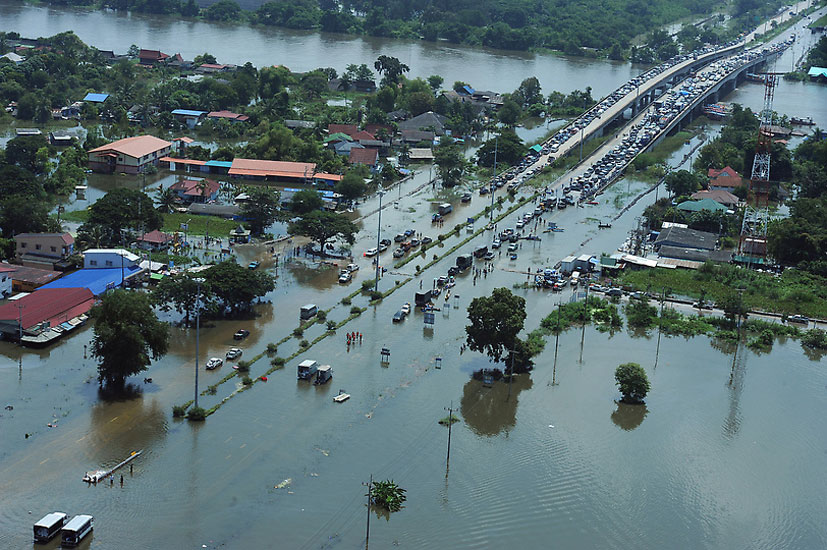
Flood water metres deep in the streets and homes of Bangkok during September, October and November took a heavy toll on the citizens and the fabric of the city. Incredibly, more than two months after the first inflows, flood water still lies across low-lying areas of the city's suburbs with fears of waterborne diseases and families struggling to salvage what they can of their possessions still the focus of local news reports.

Struggling now with the aftermath of the worst floods in the city's recent history, engineers in Thailand have mobilised to present new infrastructure projects that will prepare the city for predictable flood events in the future.

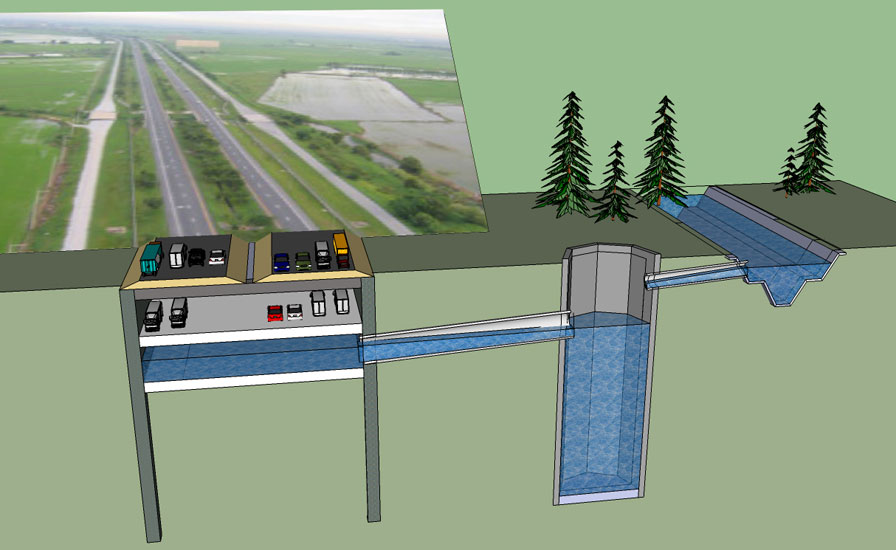
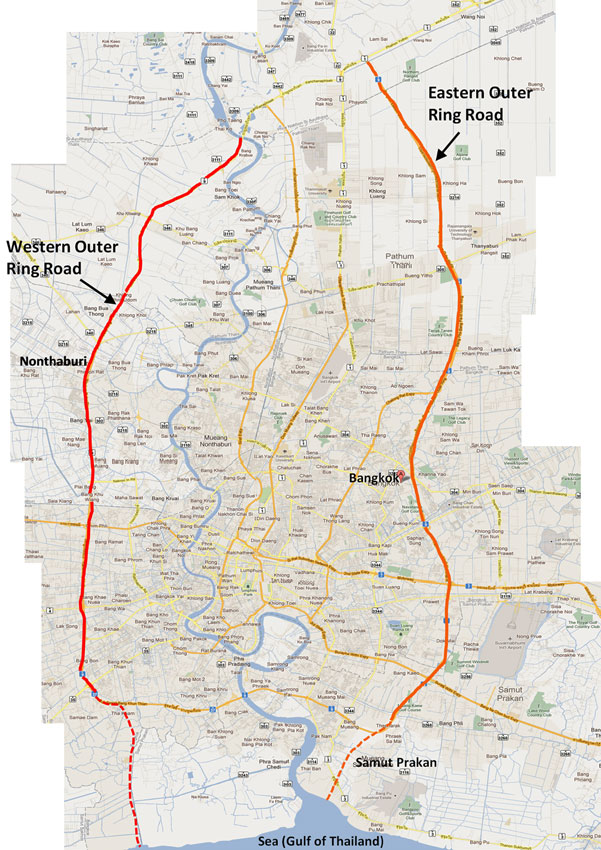
Like so many cities that have implemented comprehensive flood control systems, one of the leading plans that is gaining political support for Bangkok is based on extensive underground excavation with multi-purpose functionality possibilities. A plan to excavate a double deck cut-and-cover facility beneath the existing six to eight-lane Eastern Outer Ring Road that stretches 100km from the northern suburbs and runs parallel with the river would deliver floodwater to the Gulf of Thailand.

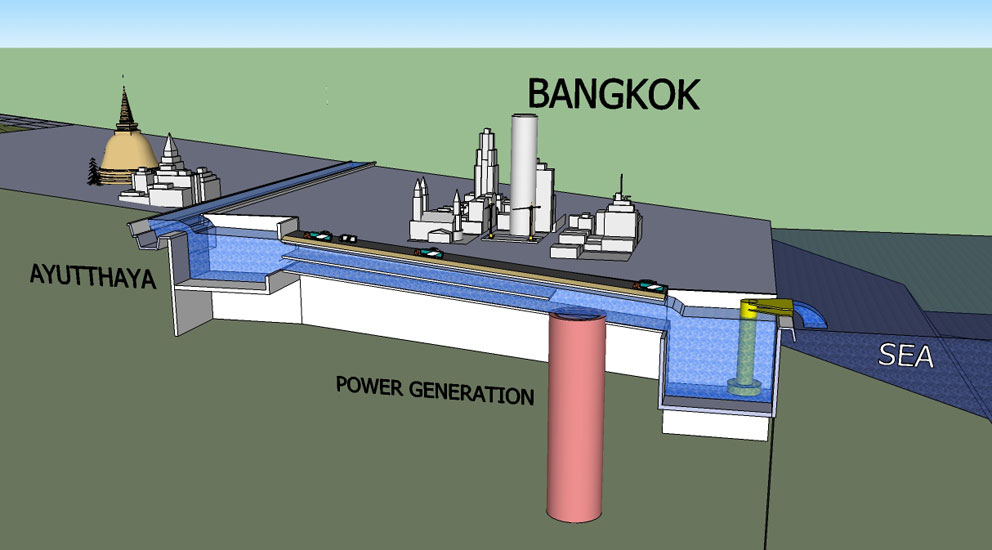
At times of heavy flooding the entire 24m wide x 10m high cut-and-cover facility would provide a channel for floodwater. During normal times, the lower deck would remain reserved as a drainage channel while the upper deck would accommodate another six lanes of highway traffic to the already heavily congested highway above.

The waters that flooded into vast areas of the northern suburbs of Bangkok were created by a perfect storm of circumstances, according to members of TUTG, the Thailand Underground and Tunnelling Group that will host the World Tunnel Congress (WTC) and 38th General Assembly of the International Tunnelling and Underground Space Association (ITA) in May next year (2012).

Underground option gaining traction as the possible solution for Bangkok

Underground option gaining traction as the possible solution for Bangkok

"First, the heavy rains of two typhoons at the start of the season in August hit the upper reaches and catchment of the Chao Phraya River," explained Zaw Zaw Aye, Tunnelling Director of the Thai construction company Seafco and Secretary General of the WTC organising committee. "After months of no rain, these were held in the reservoirs which filled very quickly.

At that point, another three typhoons hit the area in quick succession and vast amounts of water had to be released from the dams. The water had to come down the Chao Phraya River to the Gulf of Thailand. The problem in the city is that rapid urbanisation during recent years has seen new housing estates develope on land that once accommodated traditional rice paddy fields on which the annual flood waters were welcomed.

In addition, urban flood defences have not kept pace with developments that have blocked many of Bangkok's klongs, or canals, creating development barriers to Chao Phraya River flood waters."

When water released from the dams came down the river it was evident that parts of the city would flood. As well as the klongs, Bangkok has flood control defences, including a set of new drainage tunnels. The first, in the city centre (5km long x 5m diameter and with a 60m3/sec capacity) is complete; another is under construction (6km x 5m diameter); and two more are in the planning stages (the 13.5km x 5m diameter Don Muang tunnel and the 9.5km x 5m diameter Suan Luang Ro 9 tunnel which will drain an area of 85km2). But these were not able to help Bangkok to full measure on this occasion.

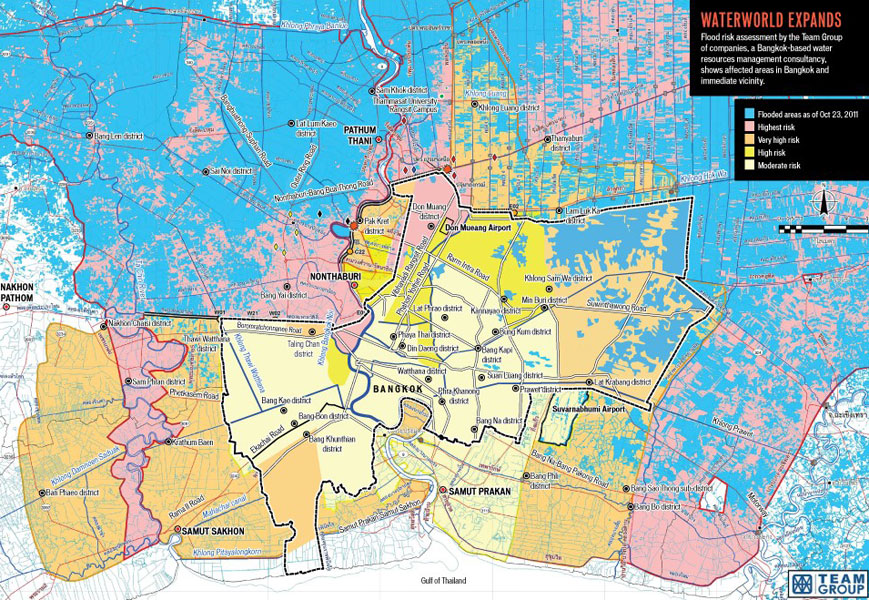
Extent of the floods around Bangkok's protected city centre

"The current systems can manage between 6-10 million m3/day," explained Zaw, "but more than 11 billion m3/day of water was coming down the river. The city could only drain a third of it."

City authorities used all existing systems, including floodgates and the diversion weirs on the klongs, to protect the city centre, with the surge spreading out in three directions to inundate the northern, eastern, and western areas. Even Bangkok's new international airport, opened two years ago on the east side of the city, was not spared. Many had warned against building the airport on the eastern flood plain.

Through all, Bangkok's metro system, with some 21km of the 50-60km network underground and the rest elevated, never shut down. "Some underground station entrances were closed," explained Zaw, who worked on the construction of underground sections of the system, "but the network is designed for a 100-year flood and all, or most, underground stations have elevated entrances as well as flood doors. I personally went to see how the flood doors performed in the emergency as I was involved in the design and installation of several."

As it happened, the metro was the only reliable method of transport through the wider city, including into the flooded areas on the elevated sections. "Buses could not operate and most private cars were out of action or parked on the elevated highways out of harm’s way, which completely chocked off the highways."

For other underground utility services, the potable water system was affected initially but was returned quickly to full service as much of the floodwater was not contaminated. The sewerage systems backed up and overflowed, a situation that brought with it the threat of waterborne disease and the liberal use of chlorine as a quick-fix response.

As well as damage to homes, shops and businesses, a visit to Bangkok last week by TunnelTalk revealed that even now there are stacks of sandbags on standby in the city centre. Small walls with stiles over them have been built in front of some smaller shops as a more permanent protection measure. There is also still an acute shortage of food, bottled water and drinks in the shops. There was no flood water to be seen but reports were of many low-lying areas, some including luxury residential estates, still remaining under water.

The aftermath of the disaster has included heavy criticism of Thailand's new Government and its failure to address the looming crisis, as well as inadequate management of the upstream reservoirs where officials were caught out completely by the deluge.

The reaction by the Government and City authorities has been to begin afresh the development of plans to prepare the city for what engineers know will happen again. The rapid urbanisation of the city and building on the natural floodways make a repeat of the disaster a certainty without urgent action. The new network of 5m diameter drainage tunnels is designed more for stormwater management, not for a massive surge of water down the river from upstream. Something much more substantial and of much greater capacity is needed, and tunnelling engineers in Bangkok have illustrated how underground flood mitigation methods are the only feasible option.

Chicago TARP

Chicago TARP

Chicago TARP

Tokyo G-CANS

Tokyo G-CANS

Tokyo G-CANS

Hong Kong Drainage

Hong Kong Drainage

Hong Kong Drainage

Kuala Lumpur SMART

Kuala Lumpur SMART

Kuala Lumpur SMART

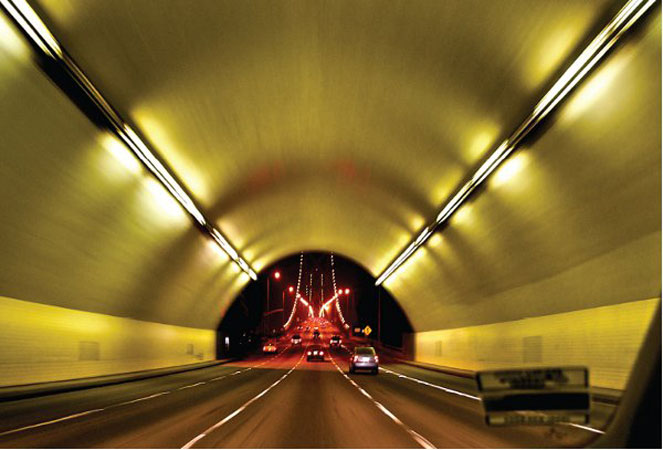
At a press conference last week TunnelTalk joined the audience to hear of how systems such as Chicago's TARP, Tokyo's tremendous G-CANS underground flood channels and retention caverns, Hong Kong's major new flood control tunnelling networks and Kuala Lumpur's innovative dual purpose Stormwater Management And Road Tunnel (SMART) project, have inspired Thai engineers to develop their own Multi-Service Underground Tunnel System, or MUSTS.

Proposed multi-purpose flood relief project runs beneath the Outer Ring Road, first on the east side and eventually also on the west side

Proposed multi-purpose flood relief project runs beneath the Outer Ring Road, first on the east side and eventually also on the west side

"The underground addresses several major issues," said Engineer Professor Dr Suchatchawi Vince Suwannasawat, Dean of Civil Engineering at King Mongkut's Institute of Technology Ladkrabang who is also President of Thailand's TUTG tunnelling society and Congress Chairman of WTC 2012.

"First it avoids expensive procurement of private property for new surface flood canal options; secondly it limits the impact of what will be a massive construction operation to the corridor of an existing public highway."

The underground solution also better allows for gravity-feed of the flood facility towards the sea, a major concern for surface options that often require large pumping systems or deep cuts. In operation, the lower deck of the underground facility would have a capacity of 130 million m3/day. This would increase to 260 million m3/day with both decks of the facility turned to flood control mode.

In addition, the multi-service system includes the possibility of generating power. Directing water down deep shafts would create the necessary hydrostatic head needed to operate a turbine installed in the bottom. Depending on the selected size of the project, between 200-600MW of electricity could be produced by extending the project's multi-service system application.

At the press conference in Bangkok on Wednesday last week, Dr Suwannasawat explained that Phase 1 of the project, for the 100km facility under the East Ring Road, would demand a Government investment of some 200 billion Thai Baht (US$6.3 billion). He went on to explain that, set against the estimated 1.4 trillion Baht cost of the current disaster, the project represents a proposal that should be advanced as soon as possible.

The multi-service functionality of the project also presents the possibility of imposing tolls on the roadway to raise funding towards its construction and maintenance. There is also potential for generating electricity to support its own operating costs.

The project has won early political backing with Deputy Governor Teerachon Manomaiphilbul of the Bangkok Metropolitan Administration speaking in support of the proposal and urging the central Government to implement the project stating: "It is a huge investment and one that I agree with."

Global theme for international congress
In welcoming the 64-member nations of the ITA to Bangkok in May next year and the anticipated 1,500-2,000 delegates, the TUTG Organising Committee has selected 'Tunnelling and Underground Space for a Global Society' as its congress theme. The fact that the host city has suffered the kind of natural disaster that looms large for many of the world's other major mega-cities will certainly draw extra interest. Delegates will be interested to hear first hand reports of how the disaster happened, how the city coped and more importantly how the Government, authorities and engineers plan to prepare the Bangkok to avoid similar disasters in future.

MUSTS includes the potential for generating electricity

MUSTS includes the potential for generating electricity

The experience will profile significantly also in the Congress Open Session, organised by ITACUS, the ITA Committee on Underground Space that is examining the development of resilient cities over the course of the next three years.

Launched this year at the WTC2010 in Helsinki in May, the theme of Delivering Better and Resilient Cities discussed in Finland, continues in Bangkok in May 2012 where the forum will centre on Planning Better and Resilient Cities, before moving to Geneva in 2013 where delegates will close the series with a discussion on Deciding Better and Resilient Cities. A special one-day registration is offered for delegates who would like to join the Open Session as a stand alone event rather than the full tunnelling congress programme. There is much to consider and develop on this wide ranging and vital topic and Bangkok's recent flood experience makes it a most appropriate venue for hosting the discussion in May 2012. A welcome and invitation to attend is extended to all from the TUTG Organising Committee.

References

Helsinki WTC2011 Congress video report - TunnelCast, May 2011
Brisbane averts underground works inundation - TunnelTalk, Jan 2011
Concerns and consequences of seismic devastation - TunnelTalk, March 2011
Santiago Metro survives massive earthquake - TunnelTalk, March 2010

WTC2012 Bangkok Thailand
ITACUS
ITA

Saturday, 26 September 2020


sinchew.com.my

玛丽安莫达.政府不注重学校英语教育


2020-09-25 07:20:00 

2348143

逆思流


任何想要破坏一个国家的人,都不必诉诸大规模毁灭性武器。他们要做的,就是修改这个国家的儿童教育,然后坐下来等待灾难性的后果。

这就是大马发生的事情。一个自我陶醉的社会,允许极端领袖控制我们生活几乎每个领域,包括教育,而今天,我们收获了成果。

我们谴责巫统/囯阵政府,因为他们的政权政治化教育和语言,让它们成了非常敏感的课题。

马哈迪在1974年出任教育部长并随后成了首相,他在教育制度上实施了固打政策,没有绩效制,以及他在英语教数理政策方面的反反复复,至少让两代大马人深受其害。

我们培养了成千上万的毕业生,但他们缺乏自信。那些没有掌握基本英语的人,在受到批评时会感到尴尬。其他人缺乏基本的沟通技巧,而有相当一部分的毕业生则抱着一种理所当然的心态。他们认为学位意味着他们可以要求更多津贴和福利,而不是向雇主展示他们的价值。

今天,许多大马父母对国民学校越来越不满。他们很常抱怨教师和教学素质低落、缺乏纪律、部分教师抱有种族主义、体育活动也有种族固打,以及存在因虐待问题而调职过来的老师,包括性虐待。

许多不满的父母把孩子送到多源流学校,那里的纪律和教学水平更高。那些有能力负担的人,会把孩子送进国际学校或海外寄宿学校。其他人则选择在家学习。马来民族主义者要求关闭多源流学校,但他们有去要求关闭国际学校吗?为什么?

最近,人们开始重新关注我们学童的英语水平很差的问题。

砂拉越首席部长阿邦佐哈里日前为砂州政府在古晋设立的第一所国际学校主持动土仪式;他在致词中表示,州政府的决定是因为有必要培养有竞争力且可以掌握国际英语的学生。他认为,许多毕业生由于英语水平太差而失业。

9月20日,大马雇主联合会(MEF)执行董事三苏丁也发表了关于英语掌握能力的类似言论。他说,良好的英语书写和会话能力,有助于公司内外沟通,同时,他也不同意雇主歧视土著毕业生的看法。

三苏丁说在私人界,有90%的大马雇主使用英语,他将土著毕业生无法在私人界找到工作的原因,归咎于他们英语水平太差。

在70年代,民政党创办人之一的陈志勤,预测民族主义者将对使用英语产生威胁。陈志勤的预言成真,因为马来极端者如今声称说英语是不爱国的表现。

如今,马来孩童不愿意说英语,因为他们被洗脑说除了马来语以外,说任何其他语言都是不爱国的表现。讽刺的是,这些马来人后来还哭着说被歧视,并抱怨说很难在私人界或跨国企业找到工作。

在独立时期,我们的学校和大学在亚洲名列前茅,但马哈迪却以固打制拉低了我们的排名。

他摧毁了英国政府一个世纪的努力,并铲除了投身教育的先贤们两个世纪的工作。消除绩效制已经至少让两代大马人失去竞争力。讽刺的是,我们拒绝的优秀生,却成了新加坡的收获。

马哈迪最近一次承认他的政策失败,是在2013年9月12日,即大马日本贸易与工业协会(JACTIM)30周年午餐宴会上。他说,掌握英语,尤其是在科学和数学领域,将有助于提高大马公立大学在世界舞台上的声誉。

当被问及对“2013年至2025年大马教育蓝图”的看法时,他说他不满没有落实英语教数理。他忘了他在摧毁我们的教育制度中所扮演的角色。

有一次,他声称在申请资讯工艺职位的333名毕业生中,只有7人合格。没有成功录取的毕业生不会说英语,因此在面试时要求以马来语进行。

当慕尤丁担任教育部长时,他甚至声称我们的教育是世界上最好的教育之一。讽刺的是,尽管向东马的学校设施注入了数亿令吉的拨款,但砂拉越的学校实际上却摇摇欲坠。那么,那些拨款是如何分配的呢?

我们需要英语来打开我们的世界,并在科学、工艺、外交、旅游、金融、国际贸易、航空和商业等领域脱颖而出。我们缺乏政治意愿来让学校更加注重英语教育,这在短期内可能会让极端政客受惠,但从长远来看,对国家却不会有所帮助。

Mariam Mokhtar: The great Putrajaya denial of English in Malaysian schools

作者 : 玛丽安莫达
文章来源 : 星洲日报 2020-09-25