My comments:
这邪魔分明是要引开人民对他和一家人搜刮的庞大不义之财的注视。所以他必须不断的制造话题引开人民对他的注意。总是阔大其词不断重复[华人很有钱]。合理化种种假借各种名堂捞取个人利益。看他上后,又为他的宝贝不成器的儿子谋取了多少权益。
他的种种邪恶的行为是要面对非常不好的下场的。他的儿子们个个住在皇宫的豪宅。我相信有一天,他们会面对Allah拷问。下场是不堪设想的。比纳吉更难看。
Blog and Tweet27/9/2018 The Curses ofCentralisation and Monopoly
The centralization
of the federal power to control the 11 states in Peninsular Malaya and two colonised
territories in Sarawak and Sabah allow the evils and sins of corruption and
collusion to penetrate to every agencies of the government.
In the
name of National Sdn Bhd, we bear witness how Dr. Mahathir, controlled the
companies Petronas, Khazanah ……and many, many other government-linked companies during his last tenure as Prime Minister of Malaysia from 1981-2003.We all bear witness how he amassed ill-gotten
wealth for himself and his family through different economic activities.He gave out one mega-project after another mega-project
which he gained in terms of n% commission, shares and so on through these
projects.It is said that he and his
family posses the wealth worth US40 billion (RM160 billion).
The
so-called National Sdn Bhd like Petronas, Khazanah ….became more or less his
private companies.It is tax-payer-funded
companies but he exploited them abusively.We bear witness how he and his son headed these companies and the shares
his other children owned in many, many companies.We bear witness how they have become
ultra-rich at the expense of the mass.
When Abdullah
Badawi succeeded him as Prime Minister from 2003-2009, he tried to undo many
bad practices of Dr. M.
When
Najib succeeded Abdulla Badawi, he created another company called IMDB which led
him to many criminal acts and sins and his downfall.Najib, had mixed-up and messed up the public
funds for his own gains and benefits though may not be as much as Dr. M.He got entangled in the global scandalous
IMDB criminal breaches of trust.But Game-time for Prime Minister to abuse his
power at will ended with the wide-awareness of the people.Thus he was flushed out by the power of the
people on 509.
Ironically, it was done or ‘killed’ by Dr. M
being the leader who had been the
arch-builder for the foundation of all kinds of corruption and collusion taking
place in the federation of Malaysia.
It is Dr. M who has created all these legacies
of concentration of power and monopoly.Hence, we bear witness all kinds of power abuse.It is nothing surprising.It is said, “No extreme can last.”
Now PH
crowned Dr. M is still so autocratic as he still appointed himself to be the
chairman of Khazanah Nasional Berhad. He
founded Khazanah Nasional Bhd in 1994 to his full advantage.He also took full advantage of Petronas which
is answerable to Prime Minister. I only
started finding out what Khazanah National Bhd which has been in existences
since 1994 is all about after 509.
In early
1998, Petronas acquired a debt-laden shipping concern controlled by Mahathir’s
eldest son Mirzan Mahathir’s Konsortium Perkapalan for RM 226 million and
assumed its debts of more than 324 million, according to Far Eastern
Economic Review stating the debt at RM 1.6 billion.
Sapura-Kenaca Petroleum
In early
November 2012, Petronas Carigali Sdn Bhd reportedly awarded a RM700 million
contract to a Sapura-Kencana Petroleum Bhd wholly owned subsidiary where
Mahathir’s son Mokhzani is a vice-chairman. When asked during a press
conference whether there was conflict of interest in the deal, Hampeh Mahathir
replied in a sarcastic tone, "Yes of course, he (Mokhzani) is given it
because I instructed Petronas. Put that in your paper. I presided over
everything. I told them, please give to my son and not to anybody else. That’s
what I have been doing all the time. When I was the prime minister, everything
was given to my children. .." Furthermore,
in 1998, when Mahathir's eldest son Mirzan Mahathir lost 0.2 billion in a Macau
casino, and his daughter was under house arrest, Mahathir ordered the then
finance minister Daim to use national reserves to rescue his son.
Proton and MV
Agusta : The Story
Former
Prime Minister Tun Dr Mahathir was appointed as Proton advisor in 2003. Since
1999, MV Agusta was heavily in debt, and the manufacturer was bought by Proton
in December 2004 for €70 million. However, the Proton management decided to
sell the stake to GEVI SpA, a Genoa-based financing company related to Carige,
in December 2005, just for a token one euro. During the
selling negotiation process, there were a lot of Malaysian voices to object the
deal, however, all was ignored by Proton. As the result, the selling deal
caused Malaysian taxpayers facing total losses of 138.4 Million Euro (RM1.92
B), including the assets that MV Agusta have. Malaysia
corruption society root cause start from Tun Mahathir era's bail out to son and
cronies company etc. At the UMNO General Assembly in 1998, a leading Anwar
supporter, Ahmad Zahid Hamidi, criticised the government for not doing enough
to combat corruption and cronyism. According
to Malaysian Maverick, Tun Mahathir's era cost RM 100 billion in
taxpayers' money. This included misuse of national reserves on silver price
speculation and BNM's forex speculaton on Tun Mahathir's order.
The Kingdom of Sarawak was a state in Borneo established in 1841 by James Brooke receiving independent kingdom status from the Sultanate of Brunei
as a reward for helping fight piracy and insurgency. Its statehood and
identity as a sovereign country was first recognised by the United
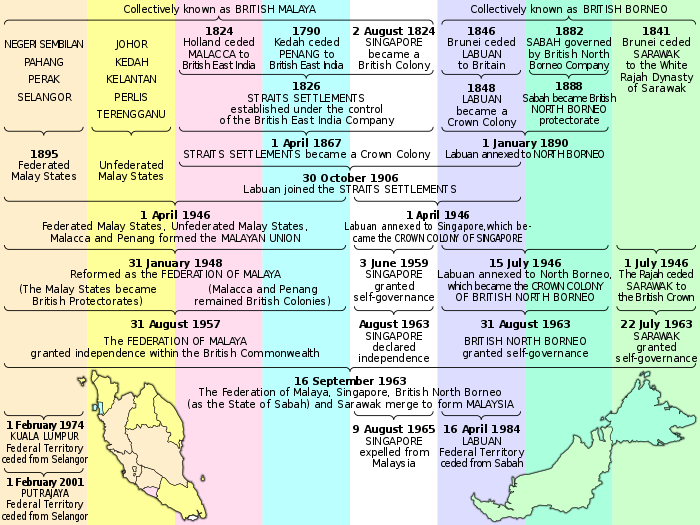
States in 1850 and then the United Kingdom in 1863. In 1888 Charles Anthoni Johnson Brooke, the successor of James Brooke, accepted a British protectorate, which it remained until 1946, when the third ruler Charles Vyner Brooke ceded his rights to the United Kingdom. Sarawak gained its independence from the British on 22 July 1963 and formed the Federation of Malaysia together with Singapore, North Borneo and the Federation of Malaya on 16 September 1963.
History
A sketch of Pangeran Raja Muda Hashim.
Sarawak was part of the Sultanate of Brunei in Borneo. During the reign of Pangeran Indera Mahkota, Sarawak was in chaos from piracy and insurgency. Sultan Omar Ali Saifuddin II
(1827–1852) the Sultan of Brunei, ordered Pengiran Muda Hashim in 1839
to restore order and it was during this time that James Brooke visited
Sarawak. Pangeran Muda Hashim initially requested assistance but James
Brooke refused. Brooke was by then an independent adventurer with his
own ship having left military employment in India after recovering from
serious battle injuries. In 1841, James Brooke paid another visit to
Sarawak and this time he agreed to assist Pangeran Muda Hashim. The
success in defeating the pirates and insurgents led to the signing of a
treaty in 1841 ceding as a reward Sarawak and Serian to James Brooke.
Thereafter, on 24 September 1841, Pangeran Muda Hashim bestowed the
title Rajah on James Brooke. He effectively became the Rajah of Sarawak
and founded the White Rajah Dynasty of Sarawak, later extending his
administration through an agreement with the Sultan of Brunei. The
uniqueness of this arrangement in becoming a Rajah without any intent of
colonising or imperialism mesmerised the British public's imagination
and gave further impetus to exploration and rise to "man who would be
king" adventurers in exotic locales.
James Brooke, who was to become the first White Rajah, received a sizeable tract of land from the Sultan. As time went on Sarawak's size would increase tremendously as more territory was leased or annexed from the Sultanate of Brunei.
The evolution of Malaysia
Japanese invasion
During World War II, Sarawak, as a British protectorate, was brought into the war against Nazi Germany, though as in World War I
it had little direct involvement with the conflict aside from providing
war materials. Resources for the defence of Sarawak, which was known
to be a strategically important goal in the event of an expected
Japanese attack, were not available because they were all needed for the
defence of the home country. When the Pacific War
began in December 1941, Sarawak was brought into the war against Japan
on the side of the Allies as part of the British Empire. Sarawak
depended upon British protection as she had very limited armed forces,
although the Sarawak Rangers were mobilised. In the late 1930s, an air field was constructed near Kuching which could be used as a base for the Royal Air Force
in the event of war with Japan, but this proved to be of little use due
to the lack of British aircraft available in the Far East. A detachment
of Indian Army infantry (2/15th Punjabi regiment) and some anti-aircraft guns were futilely dispatched to Sarawak[1] to support the Sarawak Rangers, as Sarawak was quickly overrun
due to the lack of adequate protection. Rajah Vyner was visiting
Australia at the time of the invasion and was unable to return to
Sarawak until its liberation in 1945, despite his attempts to return and
launch commando raids to fight the Japanese in the jungle. Sarawak's
small merchant marine was used by the British in the Far Eastern
campaign, with the sinking of the SS Vyner Brooke resulting in the infamous Banka Island massacre.
A government in exile was formed, although it proved ineffectual due to
the lack of contact with Sarawak. Sarawak, along with the rest of
Borneo, was liberated by the Australian Army in 1945.
Cession to the Crown Colony of Sarawak
After World War II, Vyner Brooke ceded Sarawak to the Colonial Office for a sizeable pension for him and his three daughters. Charles' nephew, Anthony Brooke, who as designated heir bore the title of Rajah Muda, initially opposed cession to the Crown along with a majority of the native members of the Council Negri, or parliament. Duncan Stewart,
the second British governor of Sarawak, was assassinated in the
resulting unrest. As of now there is no serious movement for the
restoration of the monarchy.
Demographics
Sarawak is notably different from peninsular Malaysia and even Sabah in that its ethnic groups are more varied due to the large proportion of tribal peoples such as Dayaks. Chinese migration was encouraged at various times by the Brookes.
When
James Brooke first arrived in Sarawak it was governed as a vassal state
of the Sultanate of Brunei. When he assumed control of the original
area around Kuching
in the 1840s much of the system of government was based on the
ineffective Bruneian model. James set about reforming the government and
eventually creating a civil service known as the Sarawak Service which
recruited European, mainly British officers to run district outstations.
He invited the Anglican Mission to set up church and schools, the
diocese of Borneo with its own Archbishop. Particularly, the mission
through Father McDougall set up the St. Thomas Anglican School, ( See:SMK St. Thomas)
in 1848, still the oldest established European school in Southeast
Asia. Thus, the residents became exposed to and trained in many British
and European methods and culture. However, James retained many of the
customs and symbols of neighbouring Malay monarchies and combined them
with his own style of absolute rule. James Brooke was very particular in
ensuring the local customs and beliefs of local indigenous races like
the Dayaks, Ibans, etc. were maintained and respected. As the Rajah, he
had the power to introduce laws and also acted as chief judge in
Kuching. He selected his successor, his nephew, Charles Brooke who
became the Second Rajah. Charles Brooke was responsible for acquiring
more land from the Sultan of Brunei which basically led to the land size
of Sarawak today.
He was succeeded by Charles Vyner
Brooke as the Third Rajah. While the manner of his departure was
controversial, Charles Vyner nonetheless instituted significant
political reforms, including ending the absolute rule of the Rajah in
1941 ahead of the Japanese invasion by granting new powers to the
Council Negri.
Military
Sarawak Rangers
The
Sarawak Rangers were a para-military force founded in 1872 by the
second Rajah of Sarawak, Charles Anthony Johnson Brooke. They evolved
from the fortmen which were raised to defend Kuching
in 1846. The Sarawak Rangers were first commanded by a William Henry
Rodway (1836-1924), a trainee dentist whose only military training had
been in the Torquay Volunteers when he was recruited to Kuching in 1862.
The later became skilled in jungle warfare and general policing duties,
being equipped with various western rifles, cannons and native
weaponry. This small force also manned a series of forts around the
country, performed ceremonial duties and acted as the Rajahs' personal
guard.
Aside from protecting Sarawak's borders, they
were used to fight any rebels and were engaged in a number of campaigns
during their history. The Sarawak Rangers were disbanded for a few years
in the 1930s, only to be reformed and mobilised for the Second World War in which they attempted to defend Sarawak from Japanese invasion in 1942 at the start of the Pacific War. After the abdication of Charles Vyner Brooke in 1946, the Sarawak Rangers became a colonial unit under direct British control and saw action in both the Malayan Emergency and the Borneo Confrontation.
Battle off Mukah
Jolly Bachelor engaging pirates off T.Datu, Sarawak, 1843
In November 1862 two Sarawakian warships under the Rajah Muda, Captain Brooke Brooke, attacked a force of Moro Pirates in six large proas when they raided the town of Mukah. Over the course of two or three hours, Brooke with his steamerRainbow, and his gunboatJolly Bachelor,
sank four of the pirate ships either by cannon fire or by ramming them.
Another was damaged by near hits and abandoned by her crew. In the end
only a few Sarawakians were killed or wounded while the Moros lost
several killed or wounded.[2]
Economy
By
and large the Brookes pursued a policy of paternalism, aimed at
protecting the 'native peoples' from capitalist exploitation but also
preventing the same levels of development which were evident in some
other parts of the British Empire.
While James laid much of the groundwork for the expansion of Sarawak,
it was his nephew Charles who was the great builder, both in terms of
public buildings, forts and extending the borders of the state.
The Brookes were determined to prevent the peoples of Sarawak from being exploited by Western business interests and formed The Borneo Company Limited
to assist in managing the economy. The Borneo Company Limited was also
to provide military support to the Brookes during events such as the
Chinese Rebellion when one of the company Steamers, The Sir James Brooke was used to assist in the recapture of Kuching.
The
architectural legacy of the dynasty can be seen in many of the
country's nineteenth century and colonial heritage buildings. In Kuching these include The Astana, or governor's residence, the Old Sarawak Museum, Fort Margherita,
the Square Fort, the Old Courthouse and Brooke Memorial. Several key
buildings from the Brooke period have been demolished, including the
offices and warehouses of Borneo Company.
The country
started issuing its own coinage from 1841 when it issued a one keping
coin. This was later demonetised and cents were introduced from 1863
onward, in denominations ranging from a quarter cent to 50 cents. These
were initially subdivisions of the Spanish dollar which was legal tender
in the country, until a Sarawak dollar was introduced.
The
dollar was the currency of Sarawak from 1858 to 1953. It was subdivided
into 100 cents. The dollar remained at par with the Straits dollar and
its successor the Malayan dollar, the currency of Malaya and Singapore,
from its introduction until both currencies were replaced by the Malaya
and British Borneo dollar in 1953.[3]
Culture
Modern Kuching still boasts many businesses and attractions which capitalise upon the era of the White Rajahs like The Astana, Fort Margherita, St. Thomas's Cathedral and School, and the world famous Sarawak Museum. The Brooke Dockyard, which was founded in the period of Rajah Charles, is still in operation, as is the original Sarawak Museum. The James Brooke Café and the "Royalist", a pub named after Rajah James's Schooner, pay tribute to the Brookes.